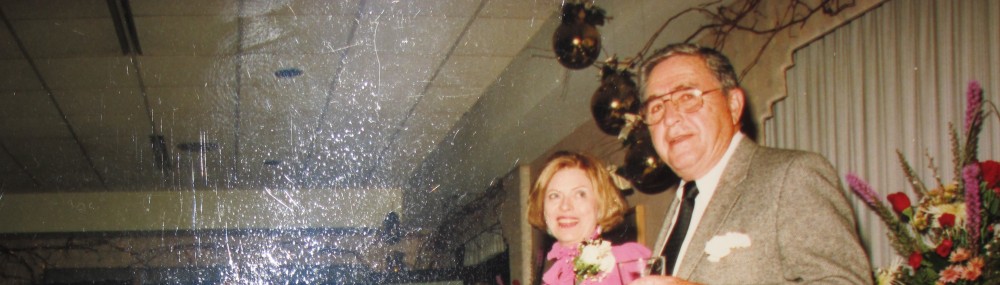
DICK SNIDER (1921-2004)
By Will Snider
(Dick Snider passed 20 years ago this week at home in Topeka. The eulogy below was delivered at his funeral Mass by his 17-year-old grandson Will Snider.)
It was a sunny day, perfect weather for a Snider family reunion. Our best time spent together is often on the golf course, and this trip was no exception. Leaving the clubhouse for the first tee, I rode in a golf cart with Grandpa. I was around ten or eleven years old, and, as soon as we were out of the sight of the course employees, he allowed me to drive the cart. My grandfather would later write in his column for the Metro News, “(Will) was a terrible driver, so I had to stop, and told him to quit going so fast, to stay on the cart path and stop hitting the rocks that lined the path.” I am not much better at driving now, but I will always remember what he deemed the best piece of advice he could give me, “Keep the cart on the path, and watch out for the rocks.”
This past spring my grandfather was issued an ultimatum. According to his doctor, a fellow golfer, he would die soon. “We’re talking months, not years,” the doctor said. He had been suffering from a pain in his midsection for some time, and one day his doctor asked him to pay a visit and bring along his wife, my grandma. He wrote, “When a doctor tells you to bring your wife with you, it sounds exactly like dirt hitting the lid of your coffin.” It was cancer.
My grandfather was always blunt, his humorous, cynical outlook attributable to his high school education, received at the hands – and occasionally the back of the hands – of the Benedictine monks of St. Gregory’s in Oklahoma. He was a small town kid whose Catholic family was cross-burned out of rural Oklahoma by the Ku Klux Klan, and, over the course of his life, he stayed on the move, changing careers more often than most people change their clothing.
After a stint with the FBI in Washington, D.C. and service in the Navy in Oklahoma during World War II, my grandfather worked as a sportswriter and later as managing editor of the Topeka Daily Capital. In the early 60’s, he ran the staff of President Kennedy’s Council on Physical Fitness. In 1964 he was the campaign manager for former Oklahoma football coach Bud Wilkinson’s bid for U.S. Senate. He made a name for himself by raising over a million dollars for the campaign, a record at the time, only to have Wilkinson lose the election in the Johnson landslide. After working for a variety of bosses, from oil companies to the NCAA and ABC-TV, my grandfather settled into semi-retirement to write a column for the Capital-Journal and most recently the Metro News on subjects including politics, history, people and our hyperbolically dysfunctional family.
After receiving news of his condition, the family came together this last summer. We toured Grandpa’s boyhood home in Oklahoma and convened for two weeks in South Carolina, looking to enjoy the surf and sun, although Hurricane Charley drove us inland in the middle of the reunion. The whole time I talked to my grandfather, trying to absorb his knowledge, his wisdom. He was no great scholar, no academic philosopher. He was genuine, funny, and one of the wisest people I’ve ever known. He was an Okie, a dustbowl child from a small town whose common sense, natural intelligence, and strong storytelling abilities allowed him to lead a full life. At the same time he was flawed and utterly human.
He was, to quote F. Scott Fitzgerald, a “cynical idealist,” a man of contradictions. His skepticism was always tempered by a great faith in humanity, and though his columns are rife with irony and humor, he occasionally gave in to warmth and introspection. The following appeared in his October 8 column:
I’d be lying if I told you I never think about the end, both when and where. I always wind up with my dad, and the night he died, in a nursing home. The family was there, and as it got very late, he told us to go home, saying, “I’m not in any pain, and I’m not afraid, so go home.” We left, and he died about two hours later.
I also think of my mother. She, too, died in a nursing home, talking like she was a teenager again, teaching in a one-room school in western Oklahoma.
I also remember the night she and my brother took me to the airport to catch a late flight, and it was stormy, with lightning. She mentioned the weather, and I said it was OK, that if the plane crashed, my troubles would be over. And she said, “Or just beginning.”
When I think of my grandfather, I think of the past few months. I think of the back porch of the beach house in South Carolina. One night, as the rest of the family prepared for bed, I sat next to my grandfather on that porch, and we discussed the golf cart incident. He reminded me to “keep the cart on the path and watch out for the rocks.” He laughed. Sighed. Smoke from his cigar drifted into the warm night air.
In Grandpa’s favorite biography of John Kennedy, a man he worked for and greatly admired, written by Ted Sorensen, a man he knew well, Sorensen quotes the book Pilgrim’s Way to describe Kennedy – quote — He will stand to those of us who are left as an incarnation of the spirit of the land he loved.” End quote. It is a fitting memorial to Grandpa. He loved the Midwest, loved Kansas and Oklahoma. He loved reading the sports page in the morning, finding the game stories for himself in agate in the box scores. He loved his column, the opportunity to afflict the comfortable and – more often than he got credit for – comfort the afflicted. He loved cigars and the occasional distilled spirit. He loved to write. But more importantly, he loved grandma—he loved her very much. He loved his kids and his grandkids. He loved the heck out of us, although he’d never say it…and he’d certainly never use the word heck.
We love him very much.
 Dick Snider