Oklahoma Catholic and the Oklahoma Klan – 94 years ago this week

(From the unpublished memoir of Dick Snider)

…I have a stronger recall of the night the Ku Klux Klan burned a cross in our front yard.  It was, and still is, the worst thing that ever happened to our family, and it was all because we were Catholics – the only Catholic family in town.  I was too young to remember it all, but my two older brothers told me about it many times.

As the cross burned, my mother, crying, pleaded with my Dad not to go outside, but he went out on the porch and confronted the Klansmen.  He told them they might as well take off their white sheets and hoods, because he knew who they were.  He also offered to take any of them on.

The Klan spokesman responded by warning my Dad he had better pack up his family and get out of town.  He added that starting the next day, my Dad’s drug store, the only one in town, was boycotted.

In the days that followed, while my Dad and Mom were facing up to the fact we had to move, some of the town leaders came to my Dad and told him, almost tearfully, they were sorry they participated in the cross burning, or that they did nothing to try to stop it.

We were singled out because we were an undesirable minority, and over the years, in my newspaper career, I’ve had to laugh when editors have lectured me on the fine points of discrimination.

We had no choice.  We had to get out of town, and to do that we had to sell almost everything we owned, including a Jersey milk cow, chickens with baby chicks, furniture and my mom’s few household treasures.  We were sent on our own Trail of Tears – uprooted and told to get to our new home the best way we could
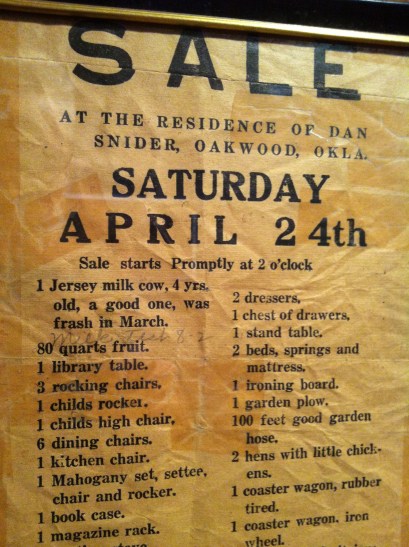
oakwood sale

Newspaper auction notice in 1926

We did it in a Model T Ford touring sedan, meaning it had a cloth top and button-down windows.  It was crammed with what we could get in it, and I’ve heard many times all the stories about the nightmare of our slow and miserable trip from Oakwood to Wyoming, and a tiny speck of a town called Veteran, where my mother had relatives and a general store needed a proprietor.

The ironic thing is that my dad, Daniel William Snider, converted to Catholicism so he could marry my mom, Leona Frances Shively.  I don’t think that he was ever sorry he did it, and they both had come a long way to the point where they met and were married in western Oklahoma, in a church that now is a farm storage building, in Anton, a town that no longer exists.

oakwood-3

Goltry, Okla., May 5, 1926. The family of Dan and Leona Snider pose with Dan’s brother John and his wife Maude and son Dent on the Snider’s way to Wyoming. From l-r top clockwise, John, Dan, Leona, Maude, Dan and Leona’s three sons Richard (Dick), Al, Dan Jr. and Dent
Augusta has mastered the art of making a buck on golf

Shawnee hatTopeka Capital Jornal – 1998

LITCHFIELD, S.C. — Our route to South Carolina took us through Augusta, Ga., scene of this weeks’ Masters golf tournament and probably the greatest financial bonanza of all the country’s sports events. Signs are up all over the place directing “golf traffic,” and to say they’re needed is like saying the Masters is just another tournament.

Fans flock in and they spend great wads of money. Corporations pay up to $15,000 to rent a house for a week while the owners leave town, and there are about 2,000 such homes available. Hotel rooms that go for $70 on the average jump to $300 and more during the tournament week.

The visitors like to play golf as well as watch it, and local courses other than Augusta National, where the Masters is played, welcome them, sort of. Greens fees that normally are in the $30 to $50 range soar to as much as $500 per round, and tee times are hard to get.

Restaurants put away their regular menus and use special Masters menus that have fewer items and Paris prices. Souvenir prices are out of sight, but few leave without some of them.

The Augusta convention bureau says that during this week there will be 10,400 visitors in the city’s hotels and motels, another 8,000 in private homes, and about 25,000 driving into town each day. They will pump $109 million into the Augusta economy. Continue reading

The NRA’s Disarming Deception

Topeka Capital-Journal – 2001

The National Rifle Association whooped it up at its national convention in Kansas City over the weekend. Members all but danced in the aisles as President Charlton Heston told them they saved the American way of life by helping elect George W. Bush, and executive director Wayne LaPierre, who really runs the NRA, declared threats to the nation’s freedom still exist.

The hootin’ and hollerin’ gun owners have reason to party right now, because everything is going their way. Membership may be at an all-time high, even without counting the dead members. There is only one major anti-gun bill in Congress, and it isn’t expected to pass.

Heston was elected to a fourth one-year term as president. He was presented a mint-condition colonial musket by the gunmen’s group, and he spoke for all of them when he held it aloft and said he would give it up only when it is taken “from my cold, dead hands.”

LaPierre and other speakers ripped the McCain-Feingold campaign finance reform bill that would limit political ads by the NRA and similar groups two months before an election, calling it an effort to destroy First Amendment rights to free speech, thus endangering the Second Amendment’s imagined rights to own guns.

All this is so much baloney. Continue reading

Keith Jackson: One of history’s best reporters

Tuesday, January 19, 1999
Topeka Capital-Journal

This is another name-dropping column, another chapter in the story of my life among the bigshots. The big name in this one is Keith Jackson, who retired earlier this month from ABC after a 47-year career that established him firmly as the top college football announcer in the land, and one of the best reporters in sports history.

Keith also was involved, at about the mid-point in his career, with producing and directing sports shows for television, and that’s when I got to know him pretty well.

In 1970 I was running NCAA Films, and as part of the college football package on ABC we produced a Sunday morning highlight show of top games played the day before, plus an annual prime-time special to open the season. Continue reading

Millionaires and Me

Topeka Capital-Journal – 1999

Just looking at me and my possessions, you wouldn’t think I was a millionaire, but it so happens I fit the mold — with one notable exception: I haven’t been close to a million bucks since the last time I shook hands with my doctor. Maybe it could be said I was even closer when he pulled on the rubber glove and gave me the examination guaranteed to cure you of being cross-eyed.

Probably because there were no more groups left to study, such as left-handed piano players or pilots with pacemakers, a Georgia State University professor has been researching the affluent for about 25 years, and his main conclusion is that most millionaires shun the trappings of wealth. Continue reading

Alfred Courtney Snider

Alfred Courtney Snider with his niece, Amy Nelson

Topeka Capital-Journal
March 25, 1998

My brother, Alfred Courtney Snider, is a retired naval aviator, and also is retired from Texas Instruments, the semi-conductor giant. I call him A.C., a compromise between Al, as he was known in the Navy and in the corporate world, and Courtney, as the family calls him. He calls me Wretched Ass, close to Richard S.

He has lived in Dallas 24 years, and when I visit my daughter Amy in nearby Southlake we usually get together for a private lunch, no matter what else is going on. The most recent one was last Friday, which happened to be my birthday, and that may be the reason he paid.

Naturally, we toasted this latest milestone in my life’s journey, and other Sniders of note. We were down to third cousins before the gears in his brain loosened up, and, as I had hoped, he told me a war story. Continue reading

The Abdows & Roye Weeks

Dick Snider
Topeka Capital-Journal – 1999

CHESAPEAKE, Va. — George and Calema Abdow and their five children were neighbors of ours for about 10 years when we lived in Kensington, Md., and during that time we saw them go from near financial ruin to riches. More specifically, they went from a busted fast food franchise to the beginnings of a business empire, and they did it the hard way.

George started over by selling flowers on a street corner in downtown Washington, D.C. By the time we moved back to Kansas he was the dominant figure in this end of the business, with other vendors working for him all over D.C. and into Maryland and Virginia. In the years that followed he became one of the biggest, if not the biggest, flower wholesaler in the area. Continue reading

On Not Becoming a Gas Magnate

Dick Snider
May 2001

We were rolling along on a Texas highway, when Wendy Herman of Wichita, at the wheel, suddenly shouted, “Wyatt.” I had to think only a few seconds before I realized what brought on this outburst.  “You’re right,” I said.  “It’s Wyatt — Oscar Wyatt.”

The day before, we had been pursuing our favorite subject, the gasoline marketing business and the people in it we knew.  We were trying to think of the name of the creator of the Coastal Corp., and we couldn’t get past “Oscar.”

Herman obviously had been churning the question long after I had given up on it, and when he remembered he gave me a smug look that said he still had all his marbles, and I obviously didn’t. Continue reading

Kansas Transplants and Native Sons

Dick Snider
Jan. 29, 1999

Kansas Native Sons and Daughters are getting together again this weekend, and it reminds me that I have a lot in common with the man generally considered to be greatest Kansan of all.

For one thing, both Dwight D. Eisenhower and I were in uniform during World War II, and for another, neither of us is a native son of Kansas. I was born in western Oklahoma; he was born in Baja Oklahoma. Also, he probably would share my feelings that it’s no big deal to belong to a club when everyone in it qualified by accident.

I came close to being a native son of Kansas. My dad was born in the state, in Miltonvale, and my mother in Nebraska. If they had met sooner, before both of them drifted into Oklahoma, it is likely I would have been a Jayhawker, rather than an Okie. I’m not sure how I should feel about the way things turned out. Continue reading

Remembering Peggy of the Flint Hills

Topeka Capital-Journal

June 16, 2000

Zula Bennington Greene never was sure where her given name originated. She would say her best guess was that her mother read a novel that had a character named Zula in it and gave it to her. That was in 1895 when she was born on a farm in Missouri.

Her first name never really mattered, because she became famous all over Kansas and beyond for the “Peggy of the Flint Hills” columns she wrote for the Topeka Daily Capital and The Topeka Capital-Journal. She wrote her first one in 1933 and continued them until her death 12 years ago this week at the age of 93.

Continue reading