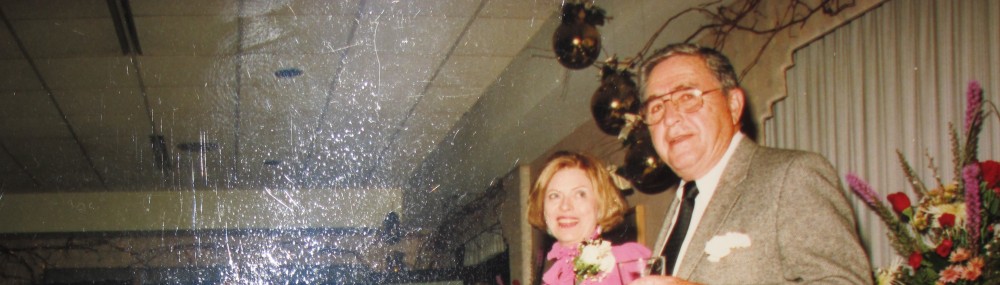
Remembering mom

Topeka Capital-Journal
May 11, 1986

The nuns who taught us in the grade school saw to it that we learned early and well the importance of Mother’s Day. Like we always did at Christmas and Easter, we hauled out the crayons and drew a special card for mom.
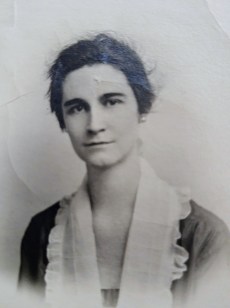
img_20200520_173328185

Leona Frances Shively

We spent so much time with the crayons, doing those cards, that it’s a wonder we learned to read and write and do our ciphering. But we did, and the cards were, in our minds, works of art.

I remember sister Mary Chrysostom best. She was my teacher in the 4th or 5th grade. She would draw a sample card on the blackboard and we would copy it as best we could.

She would come around and help the less gifted, and that’s one of the reasons I liked her. She spent a lot of time with me, so my card always came out looking pretty good.

The cover would have maybe a hill or two, some birds, a tree and a flower, and above it or below it or across it would be the word, “mother.” I was best at drawing hills and the sun. I was fair with the birds, terrible with trees and flowers.

Inside were two things. One was the message, expressing our love for mom. The other was called a “spiritual bouquet.” It was a list of prayers we had offered – or we were promising to offer – in mom’s behalf.

Even way back then I was into deficits. I’m afraid I padded my bouquet.

We would fasten these crayon-covered sheets together with colored string, or brass paper fasteners and then, at the proper time, present the card to mom.

She would express genuine pleasure at the total effort, an equally genuine surprise at the numbers button being promised. She never said anything, but I probably wasn’t fooling her.

I probably never did fool her. I know I didn’t the day a couple of other foolhardy adventurers and I skipped school to go downtown and hang out for awhile, and then go to a special high-noon baseball shootout between the Oklahoma City Indians and the Tulsa Oilers. Continue reading
A Trip to Oakwood

Topeka Capital Journal
April 14, 1999

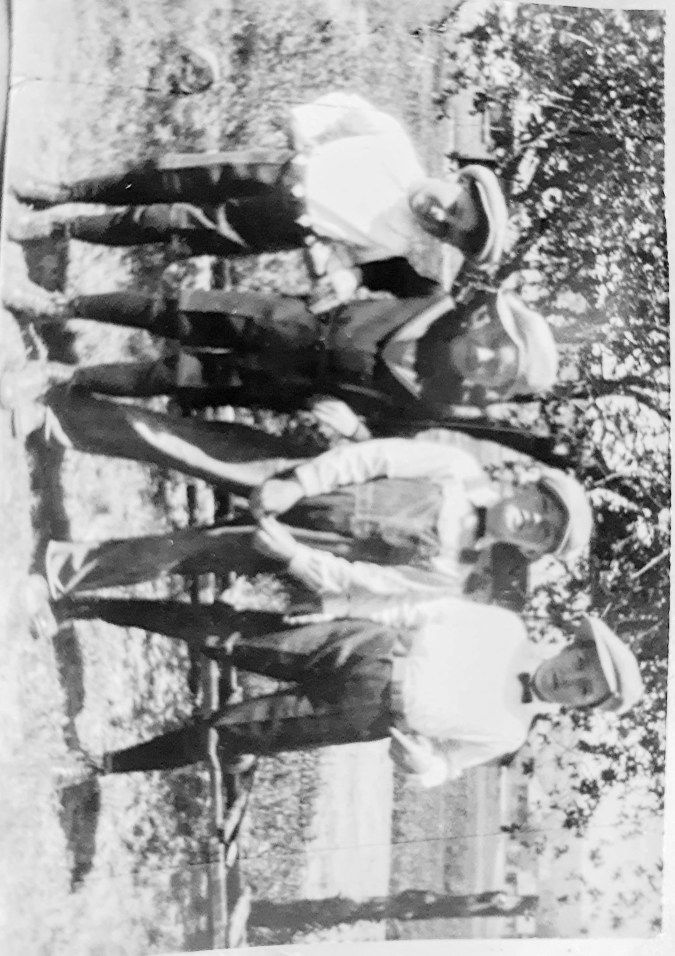
When my brother Al and I planned our trip to western Oklahoma, we knew we’d see the place where we were born, and places where a lot of our ancestors are buried. What we didn’t know is that we’d also see Rollin Shaw, our next door neighbor more than 70 years ago in Oakwood, our birthplace.

We hadn’t seen him since the Sniders moved from Oakwood in the mid 1920s, but shortly before we headed back down memory Lane, Al’s daughter Claire, found him on the Internet, listed him as a resident of Dewey County and giving a phone number.

img_20200422_164514124

From left: Dick Snider, Al Snider, Rollin Shaw, Dan Snider circa 1925

We called him and he remembered us, and after he recovered from the shock we arranged to meet next day at the Phillips 66 station in Oakwood. We had lunch, he took us on a tour of what’s left of the town, and then we went to the farm home where he has lived for the past 57 years. Continue reading

Radio Blessings on the Road to Austin

Topeka Capital-Journal
March 26, 1993

AUSTIN, Tex. – You will be pleased, I am sure, to learn the Snider family father-and-sons safari is over. It ended where it began, in the New Orleans airport. I delivered Steve and Kurt for dawn flights home, and we had a final cup of coffee, resisting the feeling the occasion called for a farewell milk punch or Ramos gin fizz.

We spent our last two nights together in New Orleans, after visiting Natchez and Vicksburg. We finally got our fill of oysters and blackened this and blackened that, better known as napalm cooking. No wonder the natives are called Ragin’ Cajuns.

While Steve and Kurt flew home, I headed for Texas to join my annual golf outing. I left the Deep South the same way I entered, motoring along in my elegant Edsel II and listening to radio evangelists.

It wasn’t that after a spell in New Orleans I felt the need to repent. It’s simply the fact I like to listen to radio preachers, and in the South you can find them all over the dial, day or night. They are entertaining, and a few have a sense of humor. Continue reading

Some Civil War stories better left to books

Topeka Capital-Journal
March 24, 1993

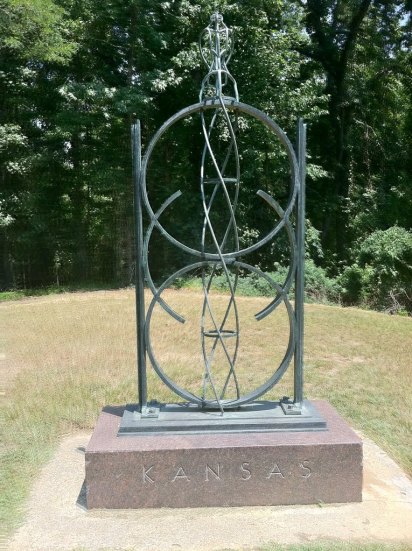
VICKSBURG, Miss. – The Kansas monument in the Civil War battlefield here is different, to say the least. The monuments, in what is now a National Park, were donated by the various states to honor the troops, on both sides, who fought here.

Some are huge, taking up hundreds of square feet or towering far above the scene of another slaughter in the war between the states. Most feature statues of soldiers with guns, or a lady of peace promising this would be the last senseless war. Some cost a million or more to build.

Most are made of marble or native stone and have special touches symbolic of the states they represent. Around every turn in the 16-mile drive through the battlefield there is another one, usually just as impressive as the last one .

KansasVicksburg

Kansas is a notable exception. Its monument is about 8 feet high and four feet wide, made of wrought iron, and cost $5,000 when it was erected in 1960. It features three circles that have a meaning never made clear to me and my two sons by the guide we hired for $20 to show us through the park.

There were many things that God never made clear to us, like what started the war, and who won. She spent all her time telling us the history books and Civil War scholars are all wet and that to this day very few people understand what happened.

When you hire a personal guide you have no way of knowing what you’ll get. You ask a woman in the reception area to get you one, and she calls the next name on the list. We drew a woman will call Connie, short for Confederate . Continue reading

Big Muddy Golf, Gambling, Blockheads

Topeka Capital-Journal
March 22, 1993

NATCHEZ, Miss. – The problem with traveling is that there are too many tourists in the places tourists like to go. This city, for example, is a popular tourist spot, but it should not be confused with New Orleans, which is a tourist trap.

New Orleans relies on gluttony, a capital sin of which we are all guilty to some degree. Natchez, on the other hand, is a long-running contest over which will last the longest – the antebellum homes that abound here, or the hordes of old folks who flock in here to see them.

The homes always win. In fact, most of them look better today than when they were built, and they all have weathered far better than the visitors.

So, you may ask, what is an old weather-beaten Okie, who wouldn’t know an antebellum home from a new Holiday Inn, doing in Natchez? Simple. I am playing daddy to two heartless offspring who sometimes seem to think I’m Daddy Warbucks. Continue reading

Credit card was part of the family

Topeka Capital-Journal
March 19, 1993

NEW ORLEANS – In the spring of 1961, a Topekan named Daryl Schoonover drove his family to Washington, DC for a sightseeing vacation, and invited me to dinner one night. I was there working in President Kennedy’s physical fitness and sports program, and my family had not yet joined me.

Schoonover charged the meal to an American Express card. I had heard of the card, but this was the first time I had seen one in operation. I asked him about it, because the idea of putting off paying for anything always has appealed to me.

He said all I had to do was apply and prove to American Express I was a person of at least modest means. The next day I found a number to call and told a few lies. Continue reading

Lessons in Family and Basketball

Topeka Capital-Journal
March 17, 1993

For weeks, our two sons, Steve in Maryland and Kurt in California, have taken turns calling me to make sure I know the game plan. I have it down pat. I am to pick them up at the New Orleans airport today. It is Saint Patrick’s Day, but that has no bearing, since the Snider family is about as Irish as Paddy’s bratwurst.

It was decided weeks ago it was time for another reunion, and the two of them, without consulting me, chose New Orleans as the meeting place. They explained it was “convenient” for all three of us.

That’s easy for them to say. They fly a few hours nonstop to get there and back, while I drive a few days to get there and back. That’s their idea of a square deal, and it gets even worse. In the four days we’ll be together, I will provide the transportation and who knows what else.

The plan calls for us to explore New Orleans, visit Natchez, Miss., the Civil War battlefield at Vicksburg, play a little golf along the way, and seek out food and spirits sufficient to maintain our stamina and morale. My stomach churns at the thought. Continue reading

A Birthday Exchange

(Dick Snider wrote this letter to his children 35 years ago today and the oldest replied to his siblings two days later – Editor)

March 20 , 1985

“How sharper than a serpent’s tooth is the sting of an ungrateful child.”
Grandma Snider

To the ungrateful:
On the occasion of my 64th birthday I take note of the fact that not a single one of my progeny sent tidings of any kind. This is duly entered in bold ink in the ledger of life, and will make it that much easier for me to bequeath my rather substantial holdings to the Redemptorists, the Benedictines, the Libertarians, the Sisters of Mercy and Oral Roberts. Continue reading

Barbara Linville Snider

Barbara Linville Snider, 89, passed peacefully in her sleep at home in Chesapeake, Va. Wednesday Jan. 22 surrounded by family.

Barbara Alice Linville was born on a farm in Harveyville, Kan. Jan. 8, 1931, the fifth of seven children of Oscar and Nellie Linville. As a young girl, she taught elementary students in a one-room school she also attended as a student, riding a horse to the school to load and light the wood stove to begin the day. She later attended Harveyville High School for a time, earning her degree from Topeka High School while working as a copygirl for the Topeka Daily Capital.

Barbara Snider

In the nation’s capital, she was a founding member of THIS – The Hospitality and Information Service, a volunteer organization of Kennedy administration families devoted to helping counterparts in the community of foreign diplomats adjust to living in Washington and the US.

Spending the next decade in Washington suburb of Kensington, Md., she was active in her children’s schools and in the social life of her community. In subsequent years, the family moved to Wichita, Kan. and Des Moines, Iowa. She and Dick later lived in Boulder, Colo., returning to Topeka in 1981 where he was an award-winning columnist at the Topeka Capital-Journal and the Topeka Metro News.

Following Dick’s passing, she moved to Chesapeake in 2012. She is survived by sons Steve (Mary Ann Allison, Hyattsville, MD) and Kurt (Rory Bennett, Del Mar, CA) daughters Anne Comer (Gary Comer, Chesapeake, VA, Amy Nelson (Duff Nelson, Southlake, TX) and Mary (Laurie Shedler, Washington, DC), nine grandchildren, and one great grandson.

In her later years, she shared lines from a favorite quote by author and artist Flavia Weedn along with her own thoughts in a note to her children: “’Some people come into our lives and quickly go. Some stay for awhile and leave footprints.’ If anyone is more blessed than I am with Steve, Kurt, Anne, Amy and Mary, then they have the same joy in life that I have. The only inheritance I can give to them is my thankfulness. Only God can give them more.”

A memorial service for friends and family will be held Saturday March 28 at the Harveyville United Methodist Church. In lieu of flowers, contributions may be made in the name of Barbara Linville Snider to the Dick Snider Scholarship for Communications and Mass Media in care of Washburn University, 1700 SW College, Topeka, Kan. 66621 .

Kansas Newspapermen Linked by Sports

Topeka Capital-Journal
Dec. 15, 1999

There were a couple of send-off parties earlier this month for Mark Nusbaum and his family, wishing them well in Lubbock, Texas, where he is the new publisher of the uniquely named Avalanche-Journal. I remember it as the only newspaper I ever saw printed blue raindrops on the front page of the weather report.

Nusbaum is a local boy who made good. He started at the Topeka Capital-Journal as a copy boy, almost as low on the totem pole as a local retiree columnist, and he was executive editor when he left.

He became a sportswriter, and as he moved up, he worked on both the news and business sides of the paper. He became a good newspaperman, well qualified to go off at the tender age of 44 and take over a big daily.

When he told his wife he was surprised by how well he got along with the key players on his new team in Lubbock, a West Texas city of 186,000, she said it was because he had enough redneck in him to make it work. It wasn’t the answer he was expecting, but he agrees. Continue reading