Manfred the Wandering Dog Finds a Home

Topeka Daily Capital
Feb. 21, 1960

It all started on Monday evening. We had finished dinner and I was going back to the office. The boys reminded me I still owed them a “surprise” for a chore they had done for me. Ann told me she still was waiting for the puzzle and “peer-fume” I had promised, and Amy made her usual pitch for candy. In other words, it started as a very normal departure. Continue reading

A Kitchen Table, Booster Trains and the Klan

(On the occasion of the late Dick Snider’s birthday, here are the first 500+ words of his memoir, found elsewhere on this site.)

On the morning after I was born, on March 20, 1921, in the tiny western Oklahoma town of Oakwood, my dad wrote a letter to my mother’s two sisters in Oklahoma City, saying, “We will not be naming our latest offspring after his Aunt Elizabeth or his Aunt Mary, as we do not think those names, grand as they may be, are fitting and proper: “IT’S A BOY!”

Years later, I reread the letter and decided that whatever talent I might have as a newspaper reporter must have been inherited from him. After all, he had a big story there, and he had a pretty good lead, he got the facts straight and he spelled the names correctly. And who knows? He may have coined the phrase that lives forever on greeting cards and cigar bands.

I was born on the kitchen table of the town’s only doctor, Edwin Sharpe, and I started life peacefully enough. I barely remember the booster trains that would come from big towns like Watonga and Custer City and throw candy to the crowd while inviting everyone to visit them and shop.

I also have vague memories of playing cowboys with my two brothers and Rollin Shaw, who lived next door. Usually, I was a bad guy and they would tie me to the windmill.

I have a stronger recall of the night the Klu Klux Klan burned a cross in our front yard.  It was, and still is, the worst thing that ever happened to our family, and it was all because we were Catholics – the only Catholic family in town.  I was too young to remember it all, but my two older brothers told me about it many times.

As the cross burned, my mother, crying, pleaded with my Dad not to go outside, but he went out on the porch and confronted the Klansmen.  He told them they might as well take off their white sheets and hoods, because he knew who they were.  He also offered to take any of them on.

The Klan spokesman responded by warning my Dad he had better pack up his family and get out of town.  He added that starting the next day, my Dad’s drug store, the only one in town, was boycotted.

In the days that followed, while my Dad and Mom were facing up to the fact we had to move, some of the town leaders came to my Dad and told him, almost tearfully, they were sorry they participated in the cross burning, or that they did nothing to try to stop it.

We were singled out because we were an undesirable minority, and over the years, in my newspaper career, I’ve had to laugh when editors have lectured me on the fine points of discrimination.

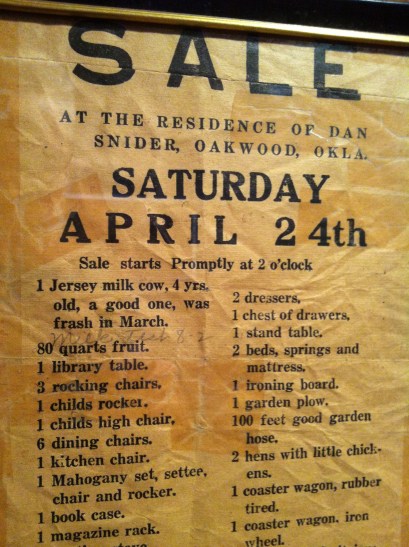
We had no choice.  We had to get out of town, and to do that we had to sell almost everything we owned, including a Jersey milk cow, chickens with baby chicks, furniture and my mom’s few household treasures.  We were sent on our own Trail of Tears – uprooted and told to get to our new home the best way we could.
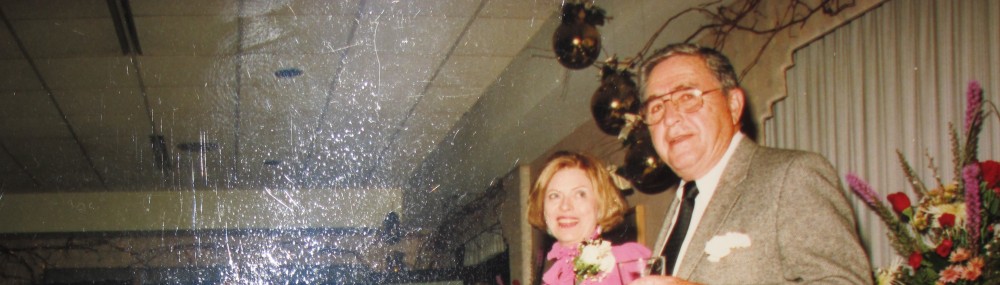
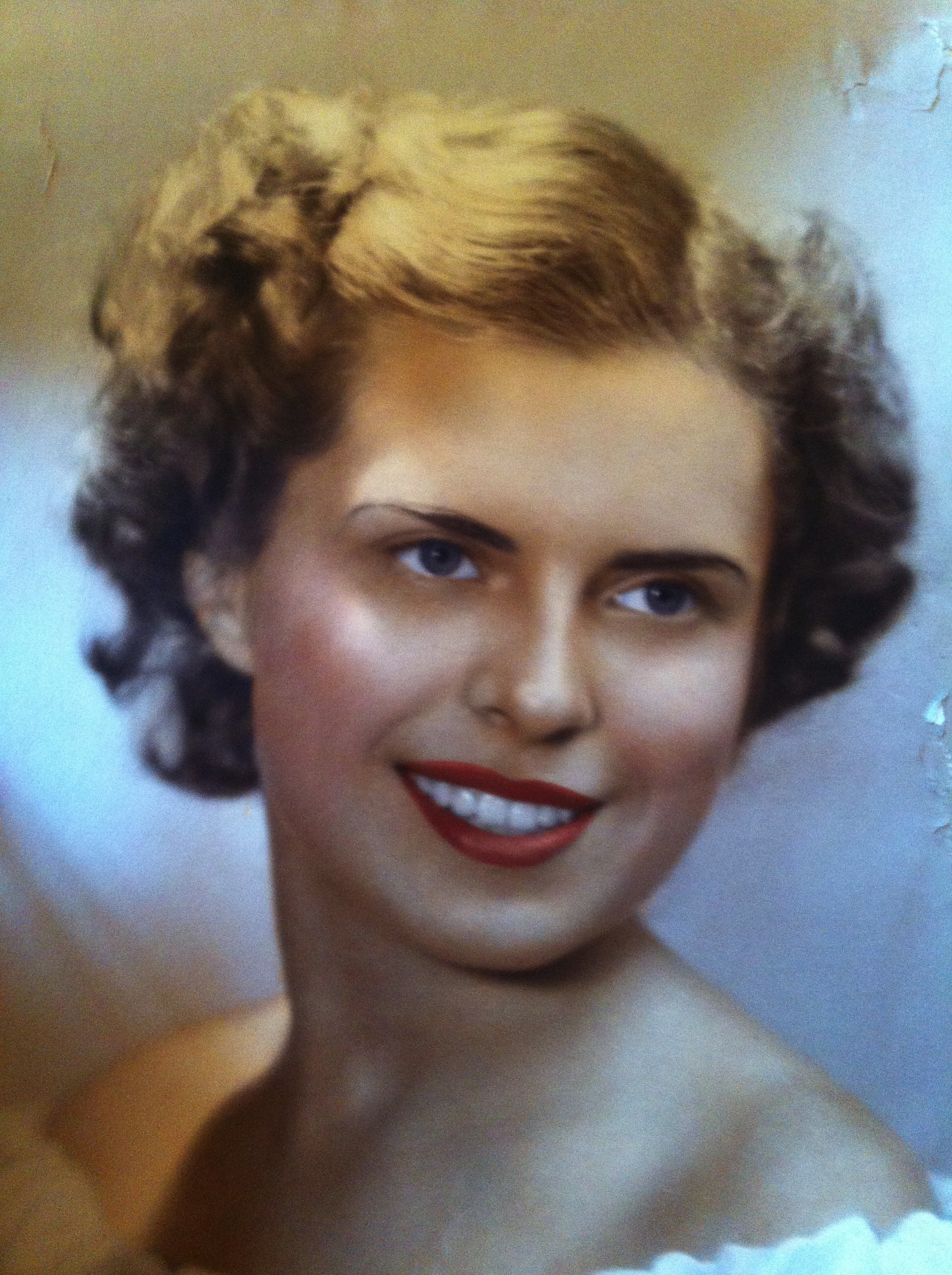
Once the right pictures were hung, surgery was a breeze

Topeka Capital-Journal – May 2000

When my wife, Barbara, and I learned last Thursday she would have surgery on Saturday I called our daughter, Amy, told her about it, and asked her to call the other four offspring. I called her because she lives near Dallas, and it was cheaper to phone her than any of the others, who are scattered from coast to coast. She also was the least likely to forget to make the calls.

She made them, and she also got to Topeka so fast I barely had time to dig out the pictures of her children and display them prominently around the house. We like to make whichever child is visiting think he or she is No. 1 in our hearts and in photo display space.

GrandmaBefore the Thursday decision there had been tests conducted or ordered by the renowned gastroenterologist, Dr. Robert Ricci. It would be an exaggeration to refer to him as the late Dr. Ricci, but he has been known to run, as he puts it, “on Ricci time.”

He was punctual, however, in reporting to us that the tests indicated surgery was called for, and in making an appointment for us to see the surgeon, Dr. James Hamilton, who is famous for having separated me from my gall bladder four years ago, and for writing learned letters to the editor on matters ranging from medicine to neighborhood blight.

When we went to see him we were accompanied by Michelle Meier, a close friend, a neighbor and a nurse who is administrator of the Kansas Medical Clinic. It wasn’t exactly the same as taking your lawyer to a real estate closing, but it made us feel more comfortable.

Dr. Hamilton explained in detail why the surgery was necessary, and what he would do. In layman’s language, he would remove a segment of bad colon, then sew the two loose ends together. It sounded simple enough. Continue reading

Oklahoma Catholic and the Oklahoma Klan – 94 years ago this week

(From the unpublished memoir of Dick Snider)

…I have a stronger recall of the night the Ku Klux Klan burned a cross in our front yard.  It was, and still is, the worst thing that ever happened to our family, and it was all because we were Catholics – the only Catholic family in town.  I was too young to remember it all, but my two older brothers told me about it many times.

As the cross burned, my mother, crying, pleaded with my Dad not to go outside, but he went out on the porch and confronted the Klansmen.  He told them they might as well take off their white sheets and hoods, because he knew who they were.  He also offered to take any of them on.

The Klan spokesman responded by warning my Dad he had better pack up his family and get out of town.  He added that starting the next day, my Dad’s drug store, the only one in town, was boycotted.

In the days that followed, while my Dad and Mom were facing up to the fact we had to move, some of the town leaders came to my Dad and told him, almost tearfully, they were sorry they participated in the cross burning, or that they did nothing to try to stop it.

We were singled out because we were an undesirable minority, and over the years, in my newspaper career, I’ve had to laugh when editors have lectured me on the fine points of discrimination.

We had no choice.  We had to get out of town, and to do that we had to sell almost everything we owned, including a Jersey milk cow, chickens with baby chicks, furniture and my mom’s few household treasures.  We were sent on our own Trail of Tears – uprooted and told to get to our new home the best way we could

oakwood sale

Newspaper auction notice in 1926

We did it in a Model T Ford touring sedan, meaning it had a cloth top and button-down windows.  It was crammed with what we could get in it, and I’ve heard many times all the stories about the nightmare of our slow and miserable trip from Oakwood to Wyoming, and a tiny speck of a town called Veteran, where my mother had relatives and a general store needed a proprietor.

The ironic thing is that my dad, Daniel William Snider, converted to Catholicism so he could marry my mom, Leona Frances Shively.  I don’t think that he was ever sorry he did it, and they both had come a long way to the point where they met and were married in western Oklahoma, in a church that now is a farm storage building, in Anton, a town that no longer exists.

oakwood-3

Goltry, Okla., May 5, 1926. The family of Dan and Leona Snider pose with Dan’s brother John and his wife Maude and son Dent on the Snider’s way to Wyoming. From l-r top clockwise, John, Dan, Leona, Maude, Dan and Leona’s three sons Richard (Dick), Al, Dan Jr. and Dent

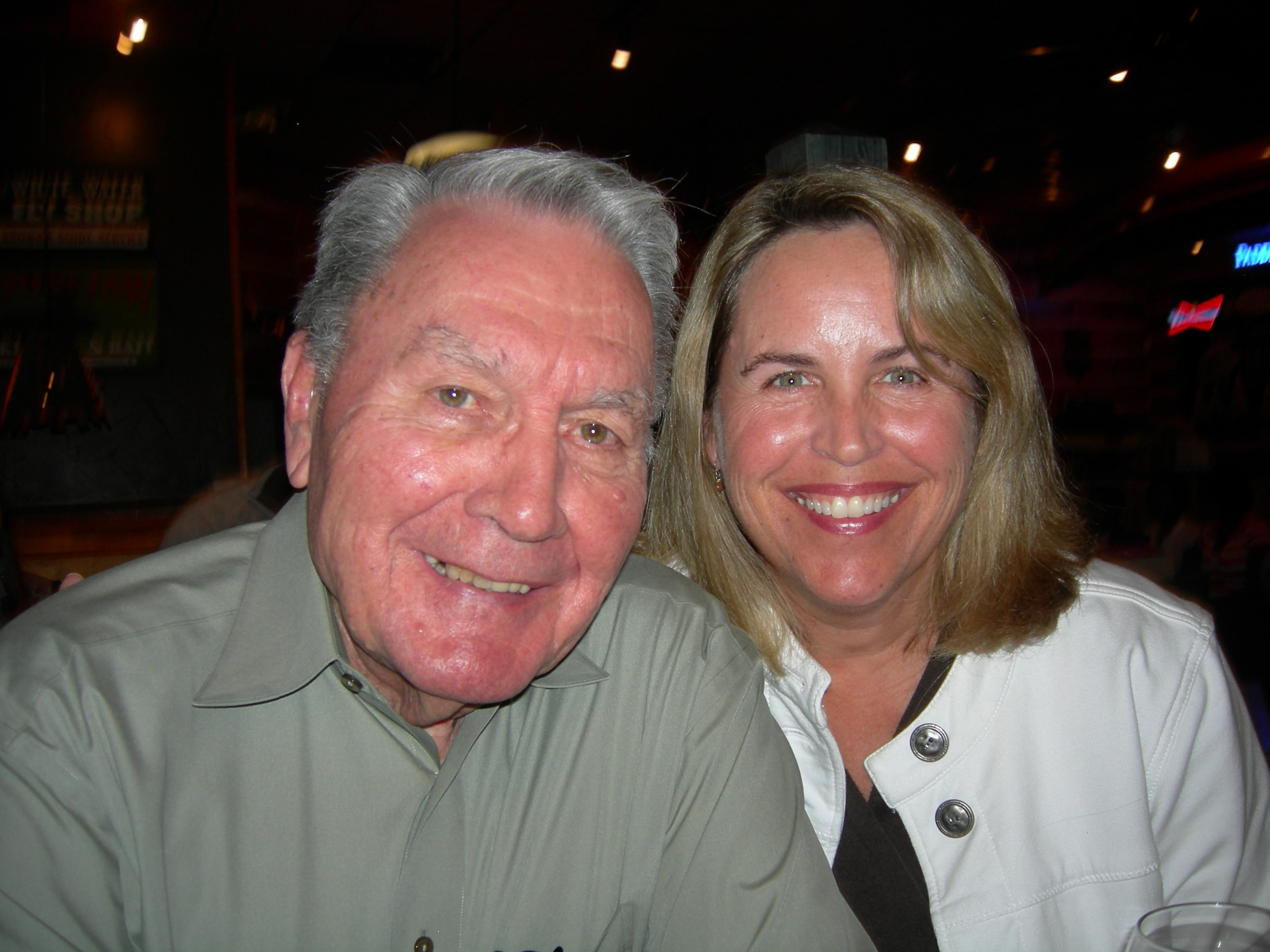
Alfred Courtney Snider

Alfred Courtney Snider with his niece, Amy Nelson

Topeka Capital-Journal
March 25, 1998

My brother, Alfred Courtney Snider, is a retired naval aviator, and also is retired from Texas Instruments, the semi-conductor giant. I call him A.C., a compromise between Al, as he was known in the Navy and in the corporate world, and Courtney, as the family calls him. He calls me Wretched Ass, close to Richard S.

He has lived in Dallas 24 years, and when I visit my daughter Amy in nearby Southlake we usually get together for a private lunch, no matter what else is going on. The most recent one was last Friday, which happened to be my birthday, and that may be the reason he paid.

Naturally, we toasted this latest milestone in my life’s journey, and other Sniders of note. We were down to third cousins before the gears in his brain loosened up, and, as I had hoped, he told me a war story. Continue reading

The Abdows & Roye Weeks

Dick Snider
Topeka Capital-Journal – 1999

CHESAPEAKE, Va. — George and Calema Abdow and their five children were neighbors of ours for about 10 years when we lived in Kensington, Md., and during that time we saw them go from near financial ruin to riches. More specifically, they went from a busted fast food franchise to the beginnings of a business empire, and they did it the hard way.

George started over by selling flowers on a street corner in downtown Washington, D.C. By the time we moved back to Kansas he was the dominant figure in this end of the business, with other vendors working for him all over D.C. and into Maryland and Virginia. In the years that followed he became one of the biggest, if not the biggest, flower wholesaler in the area. Continue reading

When Radio Ruled

Dick Snider
Topeka Capital-Journal

Radio ruled the airwaves for 30 years, just as television has reigned for the last 50, but if you weren’t there at the time it may be difficult for you to imagine a family gathered around a talking box, listening to “One Man’s Family,” Fred Allen, Jack Benny or some other top show. If you were there, you remember this Benny classic:

Holdup man: “Your money or your life?”

Benny: (Silence).

Holdup man: “I said, your money or your life?”

Benny: “I’m thinking it over.” Continue reading

Grandpa was a Kansan

Dick Snider

One of my brothers, Alfred Courtney Snider of Dallas, became interested in the life and times of our grandfather, Alfred Snider, and particularly in his Civil War record.  He asked the National Archives for help, and what he has turned up so far gives me a Kansas background I never realized I had.

After reading the material, it is obvious I should have run for state office, citing my deep Kansas roots. My ancestors were Jayhawkers long before they were Okies. Continue reading

Growing Up in Britton, Okla.

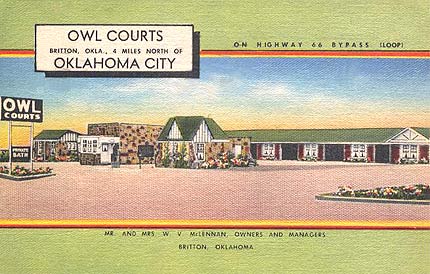
Postcard from Britton

Topeka Capital-Journal

In these times of economic turmoil, stock market calamities and energy crises, I enjoy calling a time-out to remember the simple life in Britton, Okla., where I grew up. Sometimes I think the only person in Britton who ever worried was my mother, who always was worrying about something.

Maybe she had a right to worry.  We moved to Britton in the late 1920s when my dad bought a drug store there. His timing wasn’t exactly ideal. Before he could get established in the town of about 2,000, there was the “Crash of ’29,” when the market collapsed, followed by the Great Depression.

Britton survived both. There were some unemployed men in town, but pretty soon President Roosevelt’s WPA “made work” programs came along, and everyone who wanted to work could, and had a little money to spend. Continue reading

Enough Of Phelps’ ‘Emotional Terrorism’

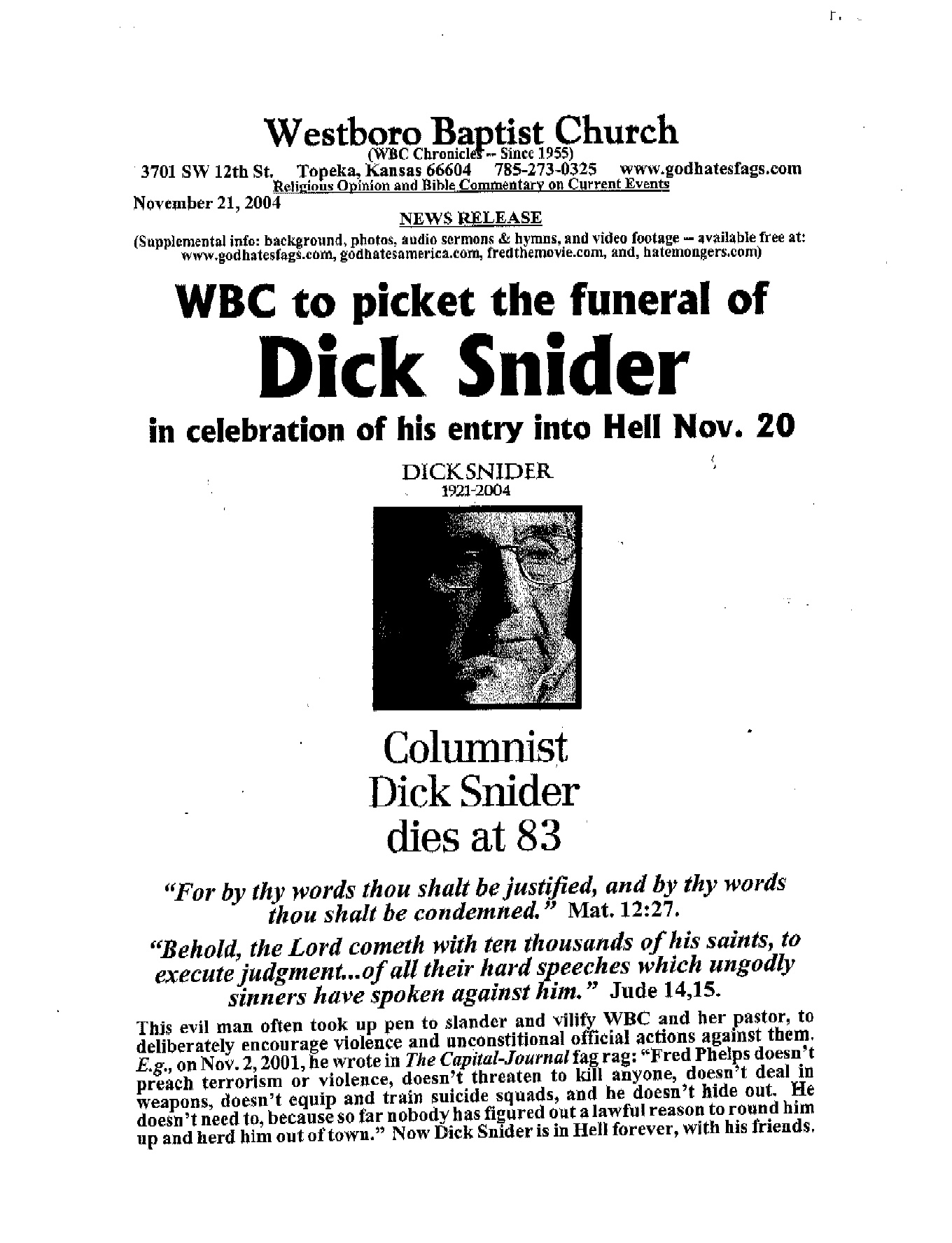
Phelps Announces a Picket

From the National Journal online

By Steve Snider, Oct. 6, 2010

In the late 1990s, Fred Phelps’ Westboro Baptist Church posted a news release to its site announcing plans to picket the funeral of my father, Dick Snider. My Dad was a Topeka newspaper columnist for many years, writing 750-word takes three days a week on politics and local characters past and present, taking not a few pokes at the pompous and self-dealing. Phelps and his picketers were a Topeka staple for years before going national to spread their targets of hate and ending up as plaintiffs in Snyder v. Phelps. The Supreme Court will hear an appeal today from the father of Marine Lance Cpl. Matthew Snyder to reinstate a $5 million judgment won against the Phelps group after they picketed Matthew’s funeral. Snyder was killed in Iraq.

My father said Phelps started targeting him for columns that chided Topeka authorities for allowing the picketers to roam the city in placard-waving packs to harass “accused” homosexuals. A newspaper profile of Dick Snider when he turned 80 put it this way: “As a youngster in Oakwood, Okla., the local chapter of the Ku Klux Klan burned a cross at the Snider family home, forcing one of the few Roman Catholic families in the small town to move elsewhere. Little wonder why Snider maintains little tolerance for fools and bigots.” Continue reading