Fall and Fair Recollections

Topeka Daily Capital
Sept. 13, 1959

It is fair time again, and that reminds me that I’ve been to a few – and that statement reminds me of one of the oldest sayings in Oklahoma. A long time ago, it was proper to express amazement by saying, “I’ve been to two hawg-callings, a turkey shoot and a county fair but I ain’t never seen nothing like this.”

Actually, it was a long time before I ever got to a real fair, but I had a pretty good buildup to the real thing.

It started in the little town of Oakwood, Oklahoma, were the only thing that brought a carnival atmosphere to this Dust Bowl setting was something called a “Booster Train. At least, I think they were called Booster Trains. Some kind of trains.

They’d whistle into town and whoever was sponsoring the train’s excursion into the sticks would give away candy and goodies, and maybe there’d be some entertainment and a speech or two.

I can vaguely remember my older brothers screaming, “Booster Train” and we’d run for the tracks. At least I think they said “Booster.” I know we ran for the tracks.

Later, in Veteran, Wyoming, there was a rodeo or two and the exhilarating experience of buying a sack of peanuts. There was a trip to Cheyenne, too, for a big rodeo and my first movie, and I remember my mother telling me, “they say that someday we’ll be able to hear them talk on the screen.” Continue reading

Family Money: Carving the Oklahoma Pie

Topeka Capital-Journal
April 28, 1997

You’ve heard this before: put some relatives and family members around a table, and in the center put some money or valuables to be divided among them, and you’ll see some greed, resentment and even some skullduggery. I am speaking as a victim when I say I’ve been there.

I was done in by my own blood brother, who lives in Dallas. Like most highbinders, he says now it was all a mistake, and he even places the blame on an Oklahoma lawyer, one of the worst kind, who is now deceased, making him one of the best kind.

I’d like to believe him, but his mistake – if you want to call it that – was so enormous, and the stakes were so high, that it is difficult for me to do. I’ll tell you the sordid story, and you be the judge.

As you read this, consider the possibility of a conspiracy among all the relatives involved in this, and try to think of a reliable lawyer who might represent me. I realize “reliable lawyer” is oxymoronic, and I may have to settle for considerably less. Continue reading

They Also Serve…War Years in the Norman (Okla.) Navy

(From the Memoir posted on this site)

At boot camp, I was named the company mailman, and suddenly everyone looked up to me. The job allowed me to skip a few marching and running drills, and I kept telling our CO, a high school football coach from Texas, that I had to see to it that the mail got through, on time, rain or shine.

And when the eight-week boot camp was over, the Navy was nice enough to send me home to Oklahoma. Comedian George Gobel, stationed at Altus, Okla., Army Air Base, later bragged that not a single Japanese plane got past Amarillo.

He had nothing on me. In my years at the Naval Air Technical Training Command base in Norman, no Japanese vessel ever was sighted on the south Canadian River… Continue reading

A Kitchen Table, Booster Trains and the Klan

(On the occasion of the late Dick Snider’s birthday, here are the first 500+ words of his memoir, found elsewhere on this site.)

On the morning after I was born, on March 20, 1921, in the tiny western Oklahoma town of Oakwood, my dad wrote a letter to my mother’s two sisters in Oklahoma City, saying, “We will not be naming our latest offspring after his Aunt Elizabeth or his Aunt Mary, as we do not think those names, grand as they may be, are fitting and proper: “IT’S A BOY!”

Years later, I reread the letter and decided that whatever talent I might have as a newspaper reporter must have been inherited from him. After all, he had a big story there, and he had a pretty good lead, he got the facts straight and he spelled the names correctly. And who knows? He may have coined the phrase that lives forever on greeting cards and cigar bands.

I was born on the kitchen table of the town’s only doctor, Edwin Sharpe, and I started life peacefully enough. I barely remember the booster trains that would come from big towns like Watonga and Custer City and throw candy to the crowd while inviting everyone to visit them and shop.

I also have vague memories of playing cowboys with my two brothers and Rollin Shaw, who lived next door. Usually, I was a bad guy and they would tie me to the windmill.

I have a stronger recall of the night the Klu Klux Klan burned a cross in our front yard.  It was, and still is, the worst thing that ever happened to our family, and it was all because we were Catholics – the only Catholic family in town.  I was too young to remember it all, but my two older brothers told me about it many times.

As the cross burned, my mother, crying, pleaded with my Dad not to go outside, but he went out on the porch and confronted the Klansmen.  He told them they might as well take off their white sheets and hoods, because he knew who they were.  He also offered to take any of them on.

The Klan spokesman responded by warning my Dad he had better pack up his family and get out of town.  He added that starting the next day, my Dad’s drug store, the only one in town, was boycotted.

In the days that followed, while my Dad and Mom were facing up to the fact we had to move, some of the town leaders came to my Dad and told him, almost tearfully, they were sorry they participated in the cross burning, or that they did nothing to try to stop it.

We were singled out because we were an undesirable minority, and over the years, in my newspaper career, I’ve had to laugh when editors have lectured me on the fine points of discrimination.

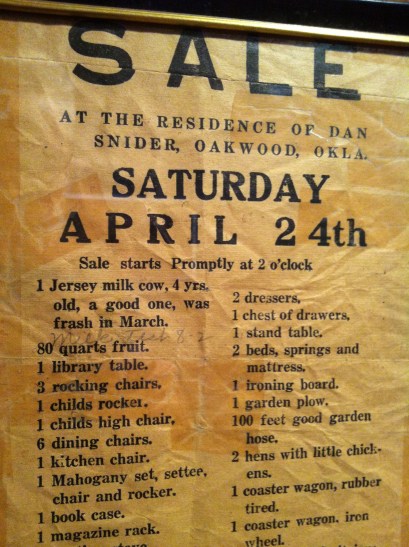
We had no choice.  We had to get out of town, and to do that we had to sell almost everything we owned, including a Jersey milk cow, chickens with baby chicks, furniture and my mom’s few household treasures.  We were sent on our own Trail of Tears – uprooted and told to get to our new home the best way we could.
Oklahoma Catholic and the Oklahoma Klan – 94 years ago this week

(From the unpublished memoir of Dick Snider)

…I have a stronger recall of the night the Ku Klux Klan burned a cross in our front yard.  It was, and still is, the worst thing that ever happened to our family, and it was all because we were Catholics – the only Catholic family in town.  I was too young to remember it all, but my two older brothers told me about it many times.

As the cross burned, my mother, crying, pleaded with my Dad not to go outside, but he went out on the porch and confronted the Klansmen.  He told them they might as well take off their white sheets and hoods, because he knew who they were.  He also offered to take any of them on.

The Klan spokesman responded by warning my Dad he had better pack up his family and get out of town.  He added that starting the next day, my Dad’s drug store, the only one in town, was boycotted.

In the days that followed, while my Dad and Mom were facing up to the fact we had to move, some of the town leaders came to my Dad and told him, almost tearfully, they were sorry they participated in the cross burning, or that they did nothing to try to stop it.

We were singled out because we were an undesirable minority, and over the years, in my newspaper career, I’ve had to laugh when editors have lectured me on the fine points of discrimination.

We had no choice.  We had to get out of town, and to do that we had to sell almost everything we owned, including a Jersey milk cow, chickens with baby chicks, furniture and my mom’s few household treasures.  We were sent on our own Trail of Tears – uprooted and told to get to our new home the best way we could

oakwood sale

Newspaper auction notice in 1926

We did it in a Model T Ford touring sedan, meaning it had a cloth top and button-down windows.  It was crammed with what we could get in it, and I’ve heard many times all the stories about the nightmare of our slow and miserable trip from Oakwood to Wyoming, and a tiny speck of a town called Veteran, where my mother had relatives and a general store needed a proprietor.

The ironic thing is that my dad, Daniel William Snider, converted to Catholicism so he could marry my mom, Leona Frances Shively.  I don’t think that he was ever sorry he did it, and they both had come a long way to the point where they met and were married in western Oklahoma, in a church that now is a farm storage building, in Anton, a town that no longer exists.

oakwood-3

Goltry, Okla., May 5, 1926. The family of Dan and Leona Snider pose with Dan’s brother John and his wife Maude and son Dent on the Snider’s way to Wyoming. From l-r top clockwise, John, Dan, Leona, Maude, Dan and Leona’s three sons Richard (Dick), Al, Dan Jr. and Dent

Millionaires and Me

Topeka Capital-Journal – 1999

Just looking at me and my possessions, you wouldn’t think I was a millionaire, but it so happens I fit the mold — with one notable exception: I haven’t been close to a million bucks since the last time I shook hands with my doctor. Maybe it could be said I was even closer when he pulled on the rubber glove and gave me the examination guaranteed to cure you of being cross-eyed.

Probably because there were no more groups left to study, such as left-handed piano players or pilots with pacemakers, a Georgia State University professor has been researching the affluent for about 25 years, and his main conclusion is that most millionaires shun the trappings of wealth. Continue reading

On Not Becoming a Gas Magnate

Dick Snider
May 2001

We were rolling along on a Texas highway, when Wendy Herman of Wichita, at the wheel, suddenly shouted, “Wyatt.” I had to think only a few seconds before I realized what brought on this outburst.  “You’re right,” I said.  “It’s Wyatt — Oscar Wyatt.”

The day before, we had been pursuing our favorite subject, the gasoline marketing business and the people in it we knew.  We were trying to think of the name of the creator of the Coastal Corp., and we couldn’t get past “Oscar.”

Herman obviously had been churning the question long after I had given up on it, and when he remembered he gave me a smug look that said he still had all his marbles, and I obviously didn’t. Continue reading

Kansas Transplants and Native Sons

Dick Snider
Jan. 29, 1999

Kansas Native Sons and Daughters are getting together again this weekend, and it reminds me that I have a lot in common with the man generally considered to be greatest Kansan of all.

For one thing, both Dwight D. Eisenhower and I were in uniform during World War II, and for another, neither of us is a native son of Kansas. I was born in western Oklahoma; he was born in Baja Oklahoma. Also, he probably would share my feelings that it’s no big deal to belong to a club when everyone in it qualified by accident.

I came close to being a native son of Kansas. My dad was born in the state, in Miltonvale, and my mother in Nebraska. If they had met sooner, before both of them drifted into Oklahoma, it is likely I would have been a Jayhawker, rather than an Okie. I’m not sure how I should feel about the way things turned out. Continue reading

When Radio Ruled

Dick Snider
Topeka Capital-Journal

Radio ruled the airwaves for 30 years, just as television has reigned for the last 50, but if you weren’t there at the time it may be difficult for you to imagine a family gathered around a talking box, listening to “One Man’s Family,” Fred Allen, Jack Benny or some other top show. If you were there, you remember this Benny classic:

Holdup man: “Your money or your life?”

Benny: (Silence).

Holdup man: “I said, your money or your life?”

Benny: “I’m thinking it over.” Continue reading

Grandpa was a Kansan

Dick Snider

One of my brothers, Alfred Courtney Snider of Dallas, became interested in the life and times of our grandfather, Alfred Snider, and particularly in his Civil War record.  He asked the National Archives for help, and what he has turned up so far gives me a Kansas background I never realized I had.

After reading the material, it is obvious I should have run for state office, citing my deep Kansas roots. My ancestors were Jayhawkers long before they were Okies. Continue reading