Now the Wilkinson Task is to Develop All-America’s Fitness

Oklahoma Today, Fall 1961

At Oklahoma, Charles B. (Bud) Wilkinson has produced many great athletes. Now, he has taken on an added task that is far more awesome in both responsibility and opportunity. He has been assigned by the President to produce a nation of physically-fit Americans.

It may surprise some to learn the two jobs have little if any, relation to each other. The answer to the physical fitness problem is not more football players. The pressing need is a program that will raise the millions of physically-deficient Americans up to minimum acceptable physical standards.

It is a tribute to Wilkinson, and to the coaching profession, that he was chosen March 23 a Special Consultant to the President on Youth Fitness. His appointment came after several conferences with President Kennedy. Although he is admittedly no expert in the field of physical education, Wilkinson outlined what he thought had to be done. The President told him to get it done. Continue reading
Black History Month perspective

Topeka Capital-Journal

This being black history month, what follows is some black history from a personal viewpoint:

In Oakwood, Okla., where I was born, and in Veteran, Wyo., where I lived for a time as a very young lad, there were no blacks.  But, in Veteran, we learned something about mixing and getting along.  At sugar beet harvest time, many Mexican families came north to work.  They were called “beet toppers” and they brought along young kids my brothers and I played with as both sides overcame the language barrier.

In Britton, Okla., where I did most of my growing up, I remember hearing black people talked about, and always referred to with the “n” word by young and old alike.

Continue reading

Growing Up in Britton, Okla.

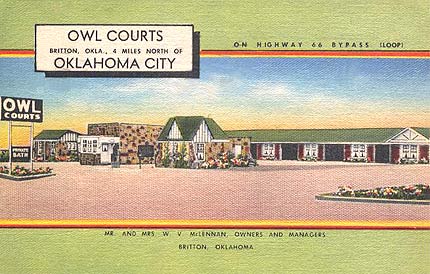
Postcard from Britton

Topeka Capital-Journal

In these times of economic turmoil, stock market calamities and energy crises, I enjoy calling a time-out to remember the simple life in Britton, Okla., where I grew up. Sometimes I think the only person in Britton who ever worried was my mother, who always was worrying about something.

Maybe she had a right to worry.  We moved to Britton in the late 1920s when my dad bought a drug store there. His timing wasn’t exactly ideal. Before he could get established in the town of about 2,000, there was the “Crash of ’29,” when the market collapsed, followed by the Great Depression.

Britton survived both. There were some unemployed men in town, but pretty soon President Roosevelt’s WPA “made work” programs came along, and everyone who wanted to work could, and had a little money to spend. Continue reading