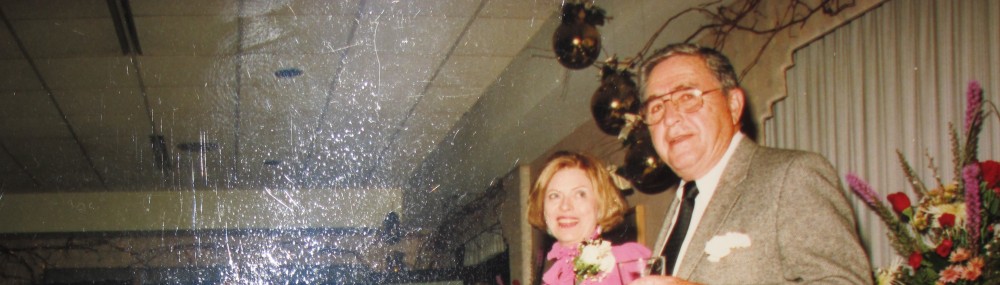
This Orange Bowl drama was off the field

Topeka Daily Capital
January 1963

WASHINGTON – This man and his wife came home at 3:30 a.m. from the New Year’s Eve revelry. They had wound up at the Statler Hilton and, as the saying goes, the Hilton was ‘tiltin when they left.

At home, the babysitter was awfully excited. “The White House has been calling,” she said. She gave the name of the man who was calling.

The call was returned. The man had been calling through the White House switchboard. Actually, he was at home.

“The courier plane is flying to Palm Beach at 8:00 a.m. today, “And a bunch of us have decided to ride it and go to the Orange Bowl game. We can just make it.

“You and your wife are invited,” he continued. “The main reason you’re invited,” he added with a sort of nervous chuckle, “is that we we figure you’re the man who can get tickets for us.”

The man listening flinched. It was something like eight hours before the kickoff, and the game was reported as a sellout.

“How many tickets?” he asked.

“Twelve, counting two for you.”

“I’ll try for 10,” said the man, “considering the takeoff is in something like four hours and we’re not exactly prepared to go.”

The man tried. He called Ken Ferris, Oklahoma’s business manager, at a Miami Beach Hotel. It was now about 4:00 a.m.

“What’s wrong?” Ferris asked anxiously.

“Nothing much, said the man, “except that I need 10 tickets.””

“I can get you 10 for our opener next season at Southern Cal,” said Ferris. “I can even get you 10 for the Texas game. What game do you mean? I know you wouldn’t call me at 4:00 a.m. and ask for 10 for today’s game.”

“Today’s game,” said the man, “is what I have in mind.”

It was fortunate at that time that Ferris is a deacon in his church, and a man not given to anger or swearing. He said he’d try, and that the party of 10 should call at the outside door of the Oklahoma dressing room no later than 11:30 AM. That meant he’d have the tickets.

The man called back to the White House caller. Then he went to sleep and barely made it to the TV set next day to see the game from there. Two weeks later, he saw Ferris. He smiled, but Ferris didn’t.

“That guy never picked up those tickets,” Ferris said. “Nobody ever showed up. We got stuck with $65 worth of tickets.”

It was another two weeks before the mystery cleared. It seems the president visited the Oklahoma dressing room at about 11:30, and that local policemen had that area blocked. Nobody – absolutely – except the president’s party could get near the dressing room door.

“It was sort of a mess,” said the man who was to pick up the tickets. “The local police wouldn’t let us near the place, and you can’t blame them.” they got in, but that’s another story. . . .

(Editor’s Note – January 1, 1963: Alabama defeated Oklahoma 17-0 in the Orange Bowl. In the game attended by President John F. Kennedy, the Crimson Tide were led by sophomore quarterback Joe Namath.)
Inkstained wretches on the road

Topeka Daily Capital
Oct.14, 1959

Football weekend…

We met at the airport and Charlie Howes rolled his new Comanche out of the hangar. While he was closing the hangar doors, he turned and saw Frenn working on the fuselage with his fingernail file.

“What are you doing?” Charlie asked. “Seeing if I can find any loose bolts to tighten.” He looked up then to the radio antenna, a single wire stretching from the cabin to the tail section. “What’s that?” he asked.

“That,” said Charlie, “holds the tail on. Get in.”

Frenn and Pritchard got in the back seat, and we were off the ground before three o’clock. A little after five, Charlie was calling Dallas Approach Control on the radio and the man on the other end warned, “Traffic is extremely heavy.”

Frenn looked up from the gin game long enough to tell Charlie, “You heard what the man said.” Charlie replied: “I’ve got on my light fall suit, in case we hit anything.”

Frenn paled. . . .

Continue reading

Buck O’Neil on Satchel Paige

Topeka Daily Capital
May 14, 1958

Jackie Robinson’s recent uproar over when and how Negroes reached the major leagues brings to mind again the great number of Negro stars who came along too early to take advantage of the memorable day when Branch Rickey erased the color line.

One of those is John (Buck) O’Neil, who played with and saw the biggest names in Negro baseball for 18 years. He was a star first baseman for the Kansas City Monarchs for 17 of those years, and managed them for seven years. He now is a scout for the Chicago Cubs.

He had a lifetime batting average of .300 in the Negro Major League and twice led the league in hitting with a mark of .350. He once was telling Sec Taylor of the Des Moines Register about life in the Negro League, and the conversation went like this: Continue reading

Topeka Daily Capital
May 14, 1958

Jackie Robinson’s recent uproar over when and how Negroes reached the major leagues brings to mind again the great number of Negro stars who came along too early to take advantage of the memorable day when Branch Rickey erased the color line.

One of those is John (Buck) O’Neil, who played with and saw the biggest names in Negro baseball for 18 years. He was a star first baseman for the Kansas City Monarchs for 17 of those years, and managed them for seven years. He now is a scout for the Chicago Cubs.

He had a lifetime batting average of .300 in the Negro Major League and twice led the league in hitting with a mark of .350. He once was telling Sec Taylor of the Des Moines Register about life in the Negro League, and the conversation went like this: Continue reading

March moment with a legend-to-be

Topeka Daily Capital
March 19, 1958

Adolph Rupp, Kentucky basketball coach, has a particular fondness for Kansas as a state and for Kansas State. He’s a native of Halstead, Kansas. The last time he won a national basketball title, he whipped Kansas State in the finals. And the last time he was anywhere near K- State, he bought some of the cattle he likes so well near Manhattan.

“Fine cattle, too,” he said Tuesday. “I’ve got about 350 head of registered Herefords now. They’re nice to have, except when there’s snow on the ground and you have to feed them.” Continue reading

Kemper Peacock and the overnight highlights

Kemper Peacock (second from left), Dick Snider standing

Topeka Capital Journal
Sept. 27, 1985

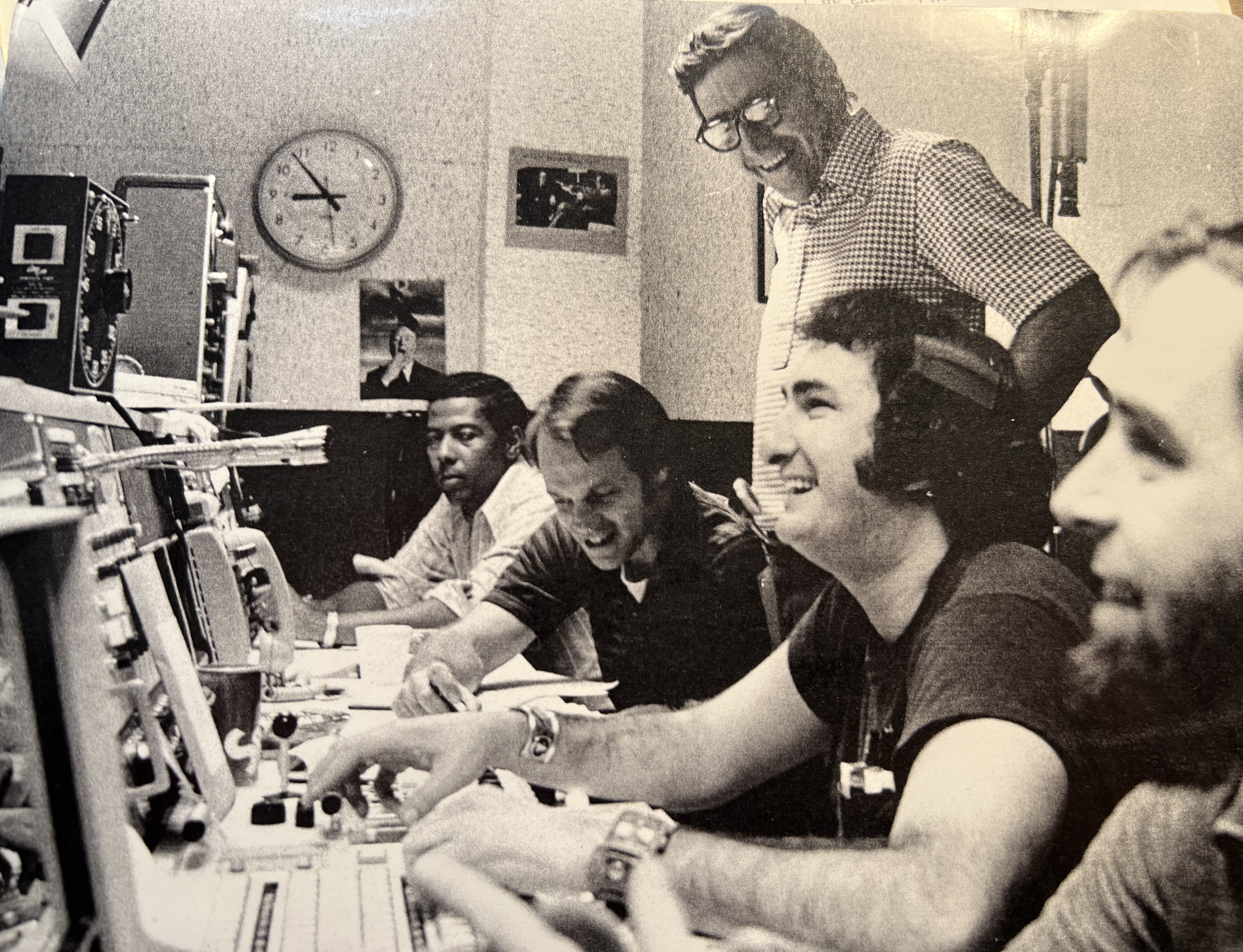
The College Football Highlights show that appeared on Sunday mornings for 15 years on ABC was one of the most unlikely offerings ever to find its way to television. For one thing, if you understood the logistics, you would say it was impossible.

For another, when it all started, the two men primarily responsible for getting it on the air were TV’s original Odd Couple. One was yours truly, who knew nothing about film or television, and the other was Kemper Peacock, who knew even less about football.

To eliminate confusion, let me say here that Kemper Peacock is not an advertising agency, a law firm, a London park or odd strain of strutting bird. He is a man – a remarkable man. Continue reading

Boggs and Hentzen and stories of the game

Topeka Capital-Journal
July 26, 1991

Before Frank Boggs retired, every newspaper columnist in the country who knew of him envied him If for no other reason than the fact he wrote seven columns a week and usually was two or three weeks ahead. He could turn on the creative tap and write a week’s worth of stuff in one sitting.

Old timers here will remember him as a member of the Capital-Journal sports staff in the 1950s. He moved on to sports jobs in places like Dallas and San Diego, but then became a newspaper executive who wrote columns as sort of a hobby.

He wound up his career where it started, in Oklahoma City, and he seemed to run things with one hand and write columns with the other. While most columnists sweat blood and wring their hands in despair, Boggs would run them off the assembly line without even a furrowed brow. And, what really burned up his colleagues was that the columns not only were numerous, but also good.

Boggs was in town this week, visiting Bob Hentzen. We played golf Tuesday, and then young insurance mogul Matt McFarland chauffeured us to a Royals game. It was a nice, long day, really spoiled only by having to sit through a sloppy 8-7 contest that lasted more than three hours.

We swapped a lot of stories, and along the way Boggs talked about the fine art of writing a column. He said he actually studied the subject, and said one of the best tips came from Russell Baker, the outstanding humor columnist for the New York Times. Continue reading

Cocktails and tales with Jack Dempsey

Topeka Capital-Journal
Jan. 10, 1959

It was at a cocktail party, and Jack Dempsey was sitting at a table, surrounded by a wide variety of boxing “fans.” Some, I am sure, we’re trying to remember when Dempsey was champion, if he ever was. They asked the questions he must have heard a million times.

“Could you have whipped Joe Lewis?”

“Did you dislike Tunney?”

“What was your toughest fight?”

“Were you ever scared?”

Dempsey said he was scared at least once, when he got into the ring with a huge Kansan named Jess Willard. Continue reading

A friend of mine named Amy,

Topeka Daily Capital
Oct. 23, 1960.

who is three years old, has as one of her best friends a man who is an inmate in the state penitentiary in Lansing. It is a friendship built on the simplest sort of foundation. It is a friendship between a man who probably needs friends and a little girl who is overwhelmed by unexpected favors.

It’s a rather long story, and it doesn’t get any shorter the way I tell it. . . . Continue reading

One evening with Willie Nelson

Topeka Capital-Journal.
April 23, 1997

Willie Nelson was on “60 Minutes” Sunday night, having a lot of fun with the fact he has finished paying the settlement for the $32 million he owed the IRS in back taxes, interest and penalties. He got into that mess because, for one thing, he was a little naive earlier in his singing career, and this column is here to tell you I don’t know him now, but I knew him then, slightly, and briefly. Continue reading

Fields of dreams and delusions.

Topeka Metro News
March 25, 2005

Devere Nelson, known to his millions of fans worldwide as Dev, used to sit in a little closet-sized control room, or studio, or whatever they called it, at WIBW and recreate baseball games that Topeka’s professional team was playing on the road. Continue reading