Doc Snider gets the post office back…in great detail

Oct. 13, 1992
Topeka Capital Journal

In my prime growing up years in Britton, Okla., one of the state’s U.S. senators was a lawyer named Thomas Pryor Gore, known as T. P. Gore, or as “TeePee” when he would use the outline of an Indian tent on his campaign literature.

This symbol and his dark complexion, which seemed even darker because of his white hair, caused most people to assume Gore was part Indian. But he wasn’t. He came from Mississippi, and he was a near-perfect picture of a politician – tall, handsome and solidly built. And, when he spoke, people listened.

He was recognized as one of the great orators of his time. Even as a teenager he was in demand as a speaker, and it was because his fame spread far beyond Mississippi that he wound up in Oklahoma and in the U.S. Senate.

There was one other thing about T.P. Gore. He was blind. Not blind in the political sense, not partially sighted in medical terms, but absolutely, totally blind. The tragic thing about it was that he wasn’t born blind, but lost his sight through two freak accidents before he was 20 years old. Continue reading

Reliving the toughest hour in network television

Topeka Capital Journal
August 21, 1995

HARBOR SPRINGS, Mich. – Three men who once were responsible for the production of “the toughest hour in network television” had a reunion here this week. They recalled the horror stories, the good times and bad, and marveled once again that even one show got on the air, and agreed it was a miracle that more than 190 shows made it without a mishap over a 13-year period.

We met here because this is where Bill Flemming, the former ABC-TV sports announcer, spends the summers. Kemper Peacock, the New York City film editor and producer, and yours truly made the long trek here to the far reaches of Michigan’s lower peninsula.

When we were involved in the show, Flemming was the host and Peacock led the production team that actually did the work period as executive producer of NCAA films, I was responsible for the overall operation and for delivering the show to ABC on time. That meant I carried the beads and led the prayers that nothing would go wrong.

The show was College Football Highlights, which aired each Sunday morning during the season.

What we did was film six or seven college football games all over the country on Saturday afternoon, and then put highlights of those games on the air Sunday morning in a neat one-hour package. A sympathetic TV critic gave it the “toughest hour” label.

It sounds pretty simple, and it would be now, but back when we started in the late 1960s, it was considerably more complicated than planning and pulling off the invasion of Normandy. Continue reading

Writing the story of Britton would be no “Picnic”

Topeka Capital Journal
July 30, 2001

Recently I enjoyed visiting the past through the musicals “Music Man” and “Oklahoma,” and the drama, “Picnic.” I’ve seen all three so many times, on the Great White Way, the semi-Great White Way, in local theaters and in high school auditoriums, on the big screen and the small screen, that I long ago lost count.

“Music Man,” my favorite, is about a con man who comes to River City, Iowa, and sells the town on starting a boys band, even though he doesn’t know a musical note from a radiator whistle. The mayor smells a rat and says he “better hear some by-God tootin’ out of them horns, “ and he finally does. The hero wins the heart of Marion, the librarian.

“Picnic” is the story of a young man who returns to his hometown in Kansas broke and looking for work, but really hoping to get by on his looks and charm. It also is the story of an aging school teacher looking for a man.

After 27 unexpected turns of events that teacher lucks into a nice, cigar chewing guy, and the young man leaves by hopping a freight – but with the town beauty queen on a bus right behind him. They’re headed for Tulsa, where he can get work as a bellhop at the Mayo Hotel. Continue reading

A Full Life for Famous Topeka Author

Topeka Metro News
July 1, 2005

This all started with an email from Charles Crawford of New York City, a KU graduate, a faithful reader and a prolific communicator. He said that with “Nero Wolfe” being resurrected for television, now is the time to write something about Rex Stout, once a Topekan and the author who created the heavyweight detective character.

Crawford also offered some items from Stout’s 1975 obituary in the New York Times, and he ended his message with the comment, “sounds like a dream life to me.” If it wasn’t, it was close, and it bolsters the idea you should keep trying until you get it right.

Stout was famous a couple of times before he gained permanent all-star status by writing 78 detective novels, 46 of them featuring Wolfe, an eccentric, chubby, beer-drinking gourmet sleuth, whose wisecracking aid and companion in crime solving was Archie Goodwin.

In the books, Wolfe weighed 286 pounds and made fat fashionable. I think I read every one of the Wolfe-Goodwin’s stories, in book form or in American Magazine or the Saturday Evening Post. I was addicted to them early in life as I was later to John D McDonald in his Travis McGee.

Rex Todhunter Stout was born in Noblesville IN, in 1886, and a few months later the family moved to Wakarusa. He was like Dwight D. Eisenhower in that he came so close to being born in Kansas the state can claim him as one of its own. Continue reading

For These Shooters, No Shots, No Hats

Topeka Daily Capital
July 15, 1959

The popular picture of the press photographer comes from the movies, or the poorer television shows. The fellow is a middle-age wise guy, with his hat turned up in front and a press card sticking in the band and – since he works for a newspaper – he naturally drinks too much and talks too much.

I was comparing this “typical” photographer with the Daily Capital’s real life staff the other day and I was a little shaken. Either times have changed or we’re on the wrong track.

Rich Clarkson, the boss, and Gary Settle, are Ivy League-trim, practically hairless and disgustingly young and single. Owen Brewer is so young, he’s Little League. Then there’s Bill Snead, and I guess you would call him National League. He’s young, too, but he’s married and he’s a Cardinals fan.

The four of them don’t own one hat among them. If anything, they talk too little, and I shudder to think what havoc a shaker of martinis could create in their darkroom. I am confident they all take heed of my admonition that bleary eyes cannot focus properly and hands that touched liquor should not touch our shutters.

It’s remarkable, the more I think about it, how these guys get us good pictures when they fail so miserably to measure up to the movie and TV versions of their profession. Continue reading

After Philly, before Oakland, Finley, Bauer and the A’s

Topeka Daily Capital
June 28, 1961

WASHINGTON – When the Kansas City A’s last played here, about three weeks ago, one of the things I heard while visiting with them was that owner Charles O. Finley had wanted to release Hank Bauer before the season opened.

They say that the loudest protests came from Joe Gordon, then the manager. He said Bauer not only was a good ballplayer, but also was a good influence on the younger players and was popular with Kansas City fans.

They say, too, that general manager Frank Lane agreed with Gordon and the two of them combined to save Bauer’s job. Continue reading

Life and Times of the Light Crust Doughboys

June 11, 2001
Topeka Capital Journal

One day recently, Elaine White, without whom there would be no daily newspaper in Topeka, was reading, on her computer, the obituaries of notables from the day before. Knowing well my cultural tastes, she asked me if I ever had heard of the Light Crust Doughboys.

I said I had virtually grown up with them, and she went on to tell me Smokey Montgomery, their banjo player, had died in Dallas of leukemia at the age of 88. Then she asked me again if I really knew about them.

I said yes indeed, and to prove it I wore bold one verse of their theme song which they used to open and close their shows:

If you like us, think we’re fine.
Sit right down and drop a line
To the Light Crust Doughboys,
From the Burrus Mill.

There’s a lot of hillbilly music history, and politics featuring a one-time Kansan, in this story, so bear with me. Considering all the pleasure they gave me, the least I can do is offer a few words in their memory. Continue reading

O’Neill on Paige and the National Pastime

Topeka Daily Capital
May 14, 1958

Jackie Robinson’s recent uproar over when and how Negroes reached the major leagues brings to mind again the great number of Negro stars who came along too early to take advantage of the memorable day when Branch Rickey erased the color line.

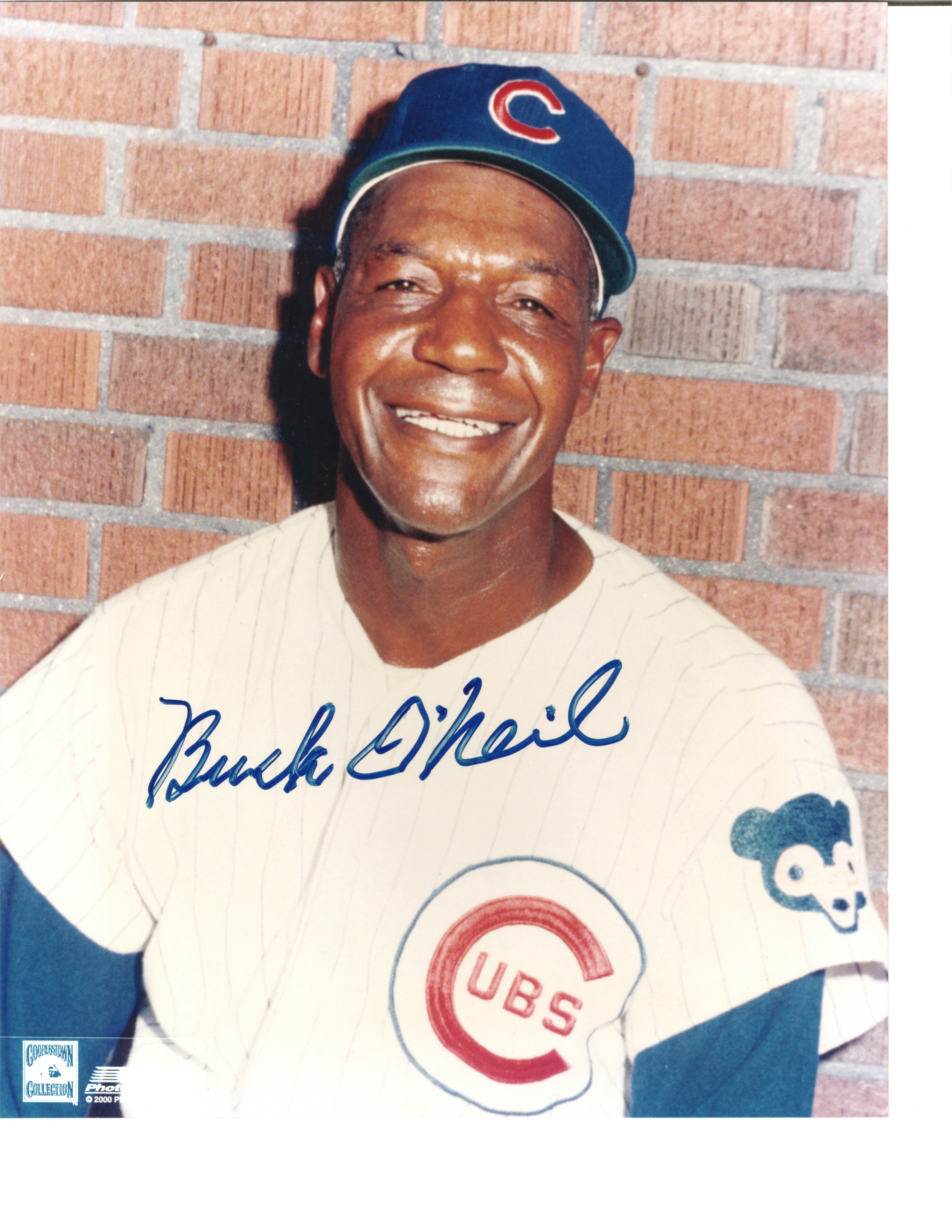
One of those is John (Buck) O’Neill, who played with and saw the biggest names in baseball for 18 years. He was a star first baseman for the Kansas City Monarchs for 17 of those years, and managed them for seven years. He now is a scout for the Chicago Cubs.

John (Buck) O’Neil

He had a lifetime batting average of .300 in the Negro major league and twice led the league in hitting with a mark of .350. He once was telling Sec Taylor of the Des Moines Register about life in the league, and the conversation went like this:

Is Satchel Paige the best pitcher Buck has seen? “I haven’t seen anyone better than old Satch,” O’Neill declared. “He was a competitor when he got in that ballpark. The trouble was to get him in it.

“Time meant nothing to him. He might go fishing just before an important game or he might get to the park gate, see you or anybody else and stand there and talk till after the game had started. Continue reading

Mother’s Day, Naming Rites and the Origin of Kurt

Topeka Daily Capital
May 10, 1959

Today is Mother’s Day, and the only thing to do is take a firm stand in favor of it. After all …

Mothers are nice and necessary, and not in that order, but they aren’t perfect. Granted, they probably try to be, particularly where their children are concerned, but it is in that area that they often are at their worst. Some mothers do to some children a thing that shouldn’t be done to a mangy dog.

I refer specifically to naming children, for which mothers are mostly responsible. Once in a while, I am told, the father has his way about naming the baby, but it is a rare occasion when the matter is handled with this efficiency and harmony.

Most mothers snarl and say, “if you want to name a baby dash have one!” Then they named their newborn without even considering Uncle Moneybags, who might have been properly impressed and looked upon the namesake as a possible heir.

Personally, I’m a 0 for 4 in naming my own, although I had a little say a little to say about #2. Continue reading

Just One More Time Around

Topeka Daily Capital
October 1960

The death of a man like Clark Gable makes you remember some of the entertaining moments he gave you, and others gave you. It makes you wish you could see and hear them again, even though you know you can’t, or at least probably never will.

Just once more , for example, I’d like to see Clark Gable on the witness stand, telling off the lawyer questioning him in “Boomtown.” And I’d go again to see him get poured on the bus in “It Happened One Night.”

There are a lot of things I’d like to see again … How about taking me back to the theater in Washington, D. C., and let me see the houselights dim and the footlights go up as the curtain parts and Glenn Miller’s band plays “Moonlight Serenade.” … Let me stay in the same place long enough to hear Tommy Dorsey play and introduce his new vocalist, Frank Sinatra …

I’d settle for just a flash of Carl Hubbell looking in from the mound and delivering a screwball… And of Pepper Martin stealing third, sliding in on his stomach …

And, please, give me one more triple dip of Black Walnut ice cream from Doc SnIder’s Drug Store …

Let me see once more my first pup, a Fox Terrier named Sparky, slip and skid on the slick linoleum of the kitchen in the house in Britton, Okla., after my mother says “Go get the dog’s can.” … Give me another evening in the backyard there, and an onion and tomato sandwich – on homemade bread …

Put me, just for a few minutes, back in the theater in New York so I can hear Robert Preston, The Music Man, sing about the “Trouble – Right Here in River City” and about “The Sadder But Wiser Girl,” … And let me hear the medicine man on Britton’s Main Street sell one more bottle of Tay-Jo Tonic …

Give me Eddie Crowder, faking to the fullback hiding the ball on his hip as he fades, and then passing for another Oklahoma touchdown … Take me back to 1952 and let me see the Sooners whip Kansas and lose to Notre Dame in the two best college football games I ever saw …

Sit me in a hotel room again with J. V. Sikes and Ears Whitworth and let me listen to them tell how they recruited football players for Georgia …

Once more, let me stand in line to be introduced to J Edgar Hoover … Let me look at the 1953 Kansas basketball team putting on the Porcupine Press , and let me interview Phog Allen when it’s over … Continue reading