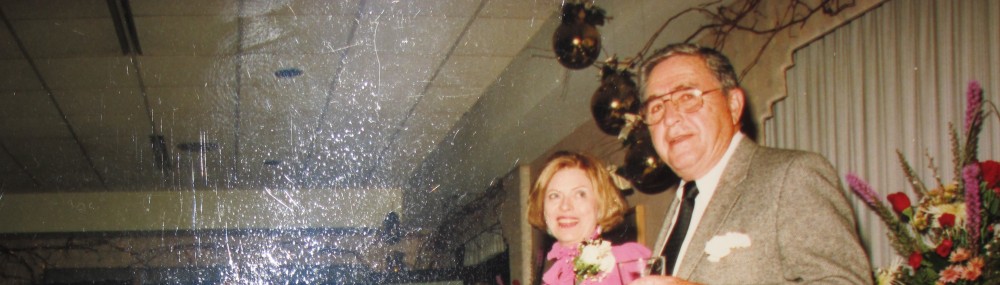
Buel and Mr. Barnes

Topeka Capital-Journal
December 24, 1986

When I think of Christmases past, which I am inclined to do when I have to write a column for Christmas Eve, it isn’t long before I get around to thinking about an aunt we called Buel and her longtime employer and friend, Mr. Barnes.

The name “Buel” was a badly mangled version of Elizabeth, uttered by one of my brothers or cousins in an early attempt at speech, and it stuck. For the rest of her life, she wasn’t Aunt Elizabeth or Aunt Buel. She was just Buel.

She was my mother’s sister, one of the three Shively girls whose mother died when they were very young. They’re all gone now, and so is their only brother, who was in his 80s when he drowned in the Platte River in his hometown of Saratoga, Wyo. while fishing.

Buel never married. She worked for Mr. Barnes for maybe 30 years. They had a close relationship, so he became close to our family, too. Buel would bring him to our house often, and at Christmas he would share in the exchange of presents and in the big meal. Continue reading

Leona Frances Shively Snider

Topeka Capital-Journal
December 6, 1985

We buried my mother, Leona Frances Shively Snider, last week in Oklahoma City. Her grave is on a wind-swept hill near the chapel in Resurrection Cemetery, beside my dad, her husband of more than 50 years, Daniel William Snider.

He was buried there in 1968. He died at 88, she at 96.

Their children were there, and a lot of their grandchildren, and even a couple of their great-grandchildren. They all came, from coast to coast, to say goodbye.

The priest who said the funeral mass is the chaplain at St. Anne’s, where my mother lived her last 13 years. He said she showed great courage, faith and patience in the last few months of her life.

I disagreed. Courage and faith, yes, patience, no. She was impatient with death. She prayed she could die and join my dad. I have the feeling that at least three times a day she looked God squarely in the proverbial eye and said, “what are you waiting for?” Continue reading

Kansas v Kansas State Remembered

Topeka Capital Journal
Oct. 24, 2001

Since Kansas State and Kansas are playing football this week, it is perhaps the right time to pass along a few irrelevant remarks about both institutions of Higher Learning. I can only hope none are construed as irreverent, because many of their fans take this game seriously, and believe everyone should.

For example, it would perhaps be irreverent to sing the I-70 blues and say there isn’t a good football team between St. Louis and Denver, except for Kansas Wesleyan in Salina, which is 5-2 for the season, and ranked in the top 25 in the NAIA poll.

The Rams on the Eastern end are unbeaten, but Missouri, the Chiefs, KU, Washburn, K-State and Fort Hays all have losing records. And at the Western end, the Broncos aren’t all that hot.

* The K State KU game Saturday would be the 100th in a string that started in 1902 if, for some reason, they hadn’t skipped playing in 1910. Why they didn’t play that year is not explained in the weighty press guides published by both schools.

It would have been a good game. K State under coach Mike Ahearn played its first 11 game schedule that season, winning 10 while outscoring the opposition 476 to 20. All but three of the games were shutouts, and the lone loss was to Colorado College, 15-8. It was a Bill Snyder-like season.

KU, in 1910, under coach Bert Kennedy, was 6-1-1 losing only to Nebraska and tying Missouri.

* One of the great characters in the history of the sports rivalry between KU and K-State is Doctor Forest C. “Phog” Allen, a legend as KU’s basketball coach, but also the football coach in the 1920 season. He had a 5-2-1 record beating K-State and Washburn, and tying Nebraska. Continue reading

Fall and Fair Recollections

Topeka Daily Capital
Sept. 13, 1959

It is fair time again, and that reminds me that I’ve been to a few – and that statement reminds me of one of the oldest sayings in Oklahoma. A long time ago, it was proper to express amazement by saying, “I’ve been to two hawg-callings, a turkey shoot and a county fair but I ain’t never seen nothing like this.”

Actually, it was a long time before I ever got to a real fair, but I had a pretty good buildup to the real thing.

It started in the little town of Oakwood, Oklahoma, were the only thing that brought a carnival atmosphere to this Dust Bowl setting was something called a “Booster Train. At least, I think they were called Booster Trains. Some kind of trains.

They’d whistle into town and whoever was sponsoring the train’s excursion into the sticks would give away candy and goodies, and maybe there’d be some entertainment and a speech or two.

I can vaguely remember my older brothers screaming, “Booster Train” and we’d run for the tracks. At least I think they said “Booster.” I know we ran for the tracks.

Later, in Veteran, Wyoming, there was a rodeo or two and the exhilarating experience of buying a sack of peanuts. There was a trip to Cheyenne, too, for a big rodeo and my first movie, and I remember my mother telling me, “they say that someday we’ll be able to hear them talk on the screen.” Continue reading

Washington Loyal To Their New Senators

Topeka Daily Capital
June 25, 1961

Washington – this city is made up of so many itinerants it has few basic loyalties. But it has at least one – the new Washington baseball club. The Senators became the New Senators when Calvin Griffith, owner of the Old Senators, moved out to start the Minnesota Twins.

The New Senators are almost a religion among baseball fans here, and they have one goal – to finish ahead of the Twins. Fans here starved for a winner for so many years they worked up an active dislike for Griffith.

When he moved out it was made clear to him nobody was sorry to see him go. Fans hated to see some of his good ballplayers go, but on the whole they liked the move.

They expected nothing of the New Senators, mostly castoffs and rookies. But right now, they’re running ahead of the Griffith’s Twins, and this is a baseball-happy town. Continue reading

Family Money: Carving the Oklahoma Pie

Topeka Capital-Journal
April 28, 1997

You’ve heard this before: put some relatives and family members around a table, and in the center put some money or valuables to be divided among them, and you’ll see some greed, resentment and even some skullduggery. I am speaking as a victim when I say I’ve been there.

I was done in by my own blood brother, who lives in Dallas. Like most highbinders, he says now it was all a mistake, and he even places the blame on an Oklahoma lawyer, one of the worst kind, who is now deceased, making him one of the best kind.

I’d like to believe him, but his mistake – if you want to call it that – was so enormous, and the stakes were so high, that it is difficult for me to do. I’ll tell you the sordid story, and you be the judge.

As you read this, consider the possibility of a conspiracy among all the relatives involved in this, and try to think of a reliable lawyer who might represent me. I realize “reliable lawyer” is oxymoronic, and I may have to settle for considerably less. Continue reading

Gentler Mud in 1990 Kansas

Topeka Capital Journal
May 14, 1990

It already is beginning to appear that mild-mannered minister Fred Phelps will be at a big disadvantage in the race for governor. The campaign is going to be down and dirty, as in muck and slime, and that’s hardly the place for a soft spoken man of the cloth.

Republican incumbents Mike Hayden and Democrat comeback hopeful John Carlin have started the mudslinging, and they seem to have enough of it to last until November. More than just a race between leaders of the two parties, this is a fight between two men who really don’t like each other.

On the side, sort of, is the shy and retiring Phelps, who would like to get into the thick of the battle, but probably won’t make it. He says he’s an old time Democrat. What does that mean? He explains: Continue reading

FBI Good Guys and the NRA Plague

Topeka Capital-Journal
May 12, 1995

Federal Bureau of Investigation agents once were hailed as heroes, but now they’re often hooted at for their blunders, real and imagined. They also are frequently criticized for their high-handedness in dealing with state and local police agencies. They never are idolized as they once were.

However the truth of the matter is that the FBI still is one of the premier police forces in the world. Their agents do thousands of things right for every one thing they do wrong. Nobody, and no organization, is perfect.

Even if FBI agents were only one-tenth as good as they are, I would vastly prefer to entrust the security of the nation and my personal freedom to them than I would some self-anointed militia.

I’d rather count on state police, county cops or the Podunk Police Department to protect me and my family than I would a bunch of men who dress up in combat gear, take assault weapons into the woods and play like they are preparing for the day they’ll have to take over the country. Continue reading

Ordinary Genius Vince Cushing

Topeka Capital Journal
January 1992

When it came time for him to graduate from the University of Notre Dame, John Cushing had a problem. Cushing, who was the father of a friend of ours, didn’t have the money to pay his tuition, and the school had this sticky rule that if your tuition wasn’t paid you didn’t graduate.

He appealed to the priests who ran the place, and they said a rule was a rule. But when he made such a solemn promise he eventually would pay what he owed they relented and sent him out into the world.

Some 30 years later he paid what he figured he owed. He gave Notre Dame a new engineering building that still bears his name. He gave more than that, too. Continue reading

Post-Thanksgiving Potpourri

Topeka Capital-Journal
Nov. 25, 1998

Herewith, in the interest of a fat-free America, some stories designed to dull your Thanksgiving Day appetite, discourage second and third helpings, and keep your belt buckle in the same notch:

– Father O’Flaherty was hearing the confessions of some schoolboys, and noted that all of them, after listing more familiar sins, asked forgiveness for throwing peanuts into the river. He thought they must be repenting for wasting food.

But his curiosity grew as it went on, and he decided to get to the bottom of it. But the last boy in a confessional said nothing about peanuts. So the priest asked him, “what about throwing peanuts in the river?”

“Father,” the boy said, “I’m peanuts.”

Continue reading